
TLDR
- Wedding details card wording should keep the main invitation clean while giving guests the information they actually need.
- The best details cards usually cover logistics like reception location, dress code, transportation, accommodations, parking, or website and RSVP instructions.
- Not every extra detail belongs in print. Stable essentials belong on the card, while longer or changeable information usually belongs on your wedding website.
- A good details card is clear, specific, and easy to scan. It should not read like a miniature instruction manual.
- Registry notes and gift language should stay off the invitation suite.
You do not need to squeeze every useful wedding detail onto the main invitation. In fact, that is usually the fastest way to make the whole suite harder to read. Wedding details card wording exists to solve that exact problem.
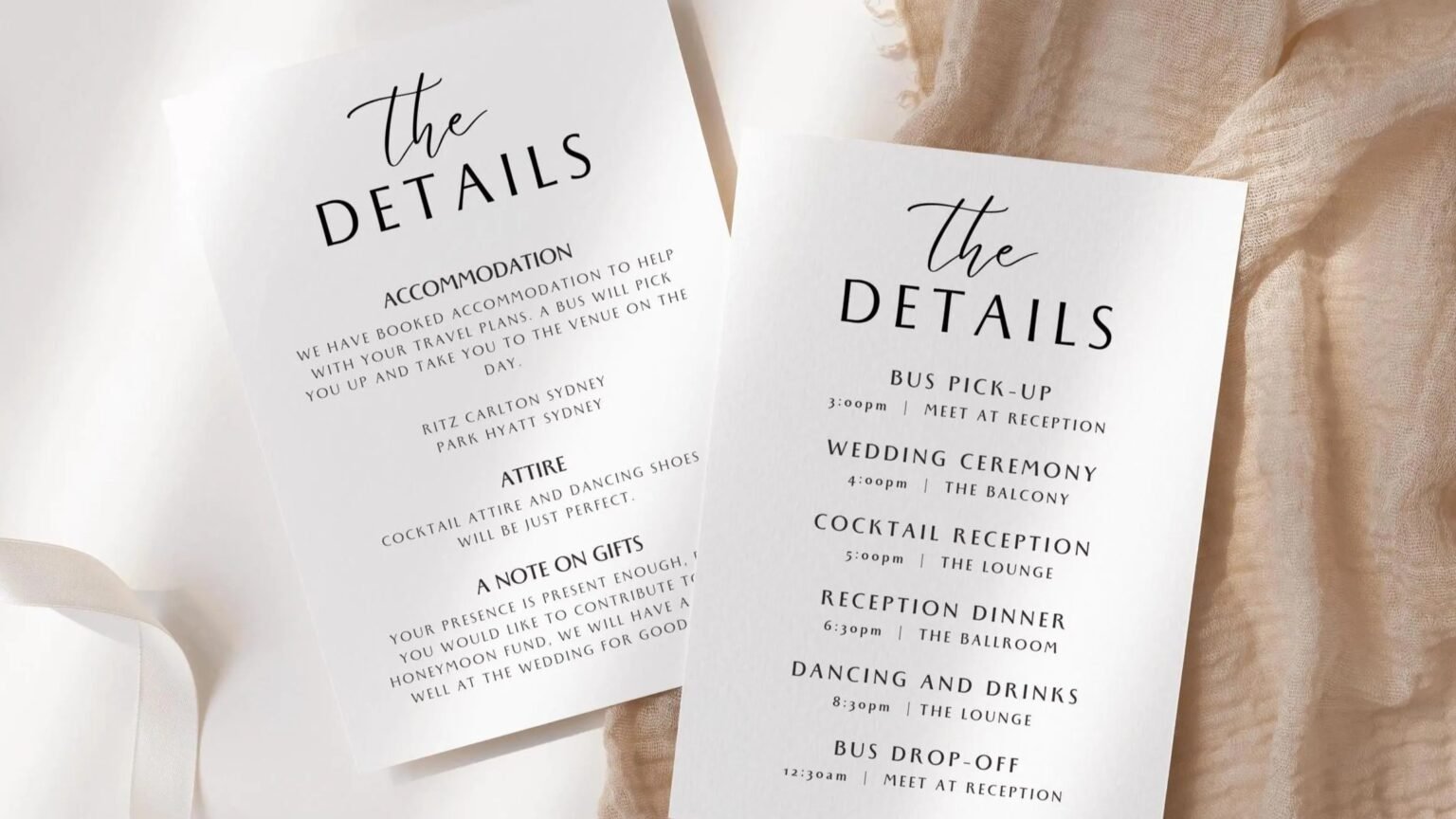
A details card, sometimes called an enclosure card or insert card, gives you a place for the extra information guests need without asking the main invitation to do too much. That is the whole job. The invitation announces the event. The details card supports it.
On PrintInvitations, Wedding Details Cards are there to keep the suite clearer, not busier. And that is the standard worth using: if the insert makes the invitation easier to understand, it belongs. If it creates more clutter, it probably does not.
What wedding details card wording is supposed to do
The main invitation should carry the core information: who is getting married, when the ceremony happens, where it takes place, and how the event is framed. Once you start adding hotel blocks, shuttle notes, dress code, parking instructions, a wedding website, after-party details, and brunch times, the whole thing starts to feel crowded.
That is where wedding details card wording helps.
A good details card does three things at once. It protects the look of the main invitation. It gives guests the practical information they need. And it organizes that information in a way people can actually use.
That last point matters more than people expect. Guests do not read invitation suites like novels. They scan them. They glance for the date, the venue, the RSVP deadline, the dress code, the hotel, the shuttle, the website. The easier those details are to find, the fewer follow-up texts you get later.
What belongs on a details card, and what does not
This is the easiest way to think about it.
The details card is for the information that matters, but does not belong on the main invitation.
That often includes:
- reception location and timing
- dress code
- parking instructions
- shuttle or transportation details
- hotel block or accommodation notes
- wedding website
- RSVP instructions, especially for online replies
- extra weekend events, when relevant
What usually does not belong on a details card:
- registry information
- gift requests
- long backstory copy
- information that is likely to change
- six paragraphs of travel advice that would work better on a website
Traditionally, gift language stays off the invitation suite entirely. Modern couples still tend to follow that rule, even when the rest of the wording is relaxed. A website can handle registry information far more gracefully.
Wedding details card wording for the most common situations
The easiest way to build wedding details card wording is to start with the actual problem you need the card to solve.
Reception at a different location
This is one of the most common reasons to include an insert card.
Formal
Reception to follow
The Grand Ballroom
525 East Maple Street
Salt Lake City, Utah
Modern
Join us afterward for dinner and dancing
The Grand Ballroom
525 East Maple Street
Salt Lake City, Utah
If the reception is in the same place and starts right away, you may not need a separate card at all. A simple “Reception to follow” line on the invitation is often enough. But once the reception location changes, the details card starts earning its keep.
Gap between ceremony and reception
This is where vague wording creates problems.
Clear version
Ceremony at 2:00 p.m.
Reception begins at 5:00 p.m.
Please join us for cocktails, dinner, and dancing
That gives guests a realistic sense of the day. It is better than making them guess whether there is a three-hour gap or a short transition.
Dress code
Guests appreciate dress code guidance much more than people think.
Formal
Black tie attire
Moderately formal
Cocktail attire
Softer, more descriptive
Garden attire requested
Please note that the ceremony will take place on grass
That last version is especially useful because it turns a vague style note into practical help. A details card does not need to sound stiff. It does need to prevent avoidable confusion.
Parking or venue access
This is one of those details people forget until it suddenly matters.
Example
Complimentary parking is available in the north lot
Please enter through the garden gate on Birch Avenue
Or:
Valet parking will be available at the venue entrance
Or:
The ceremony site is a short walk from the parking area
Comfortable shoes are encouraged
Good details card wording is often less about elegance and more about removing friction.
Hotel block or accommodations
For weddings with traveling guests, accommodation notes are often worth printing.
Example
A block of rooms has been reserved at The Alder Hotel
Please book by May 10 using the Dunn-Mercer wedding block
Or:
Nearby accommodations and travel information can be found at
ryanandalex.com
The tradeoff here is simple. A short booking note works well in print. A long list of hotel options usually works better on the website.
Transportation or shuttle wording
Transportation notes are perfect for a details card because they are useful and easy to miss elsewhere.
Example
Shuttle service will depart from The Alder Hotel at 3:30 p.m. and 4:00 p.m.
Return shuttles will run from 9:30 p.m. to 11:00 p.m.
This is much easier for guests to use than burying the same information in a long FAQ page.
Wedding website and RSVP instructions
A details card is often the right place to direct guests online.
Example
For additional details and to reply online by May 10, please visit
ryanandalex.com
Or:
Kindly reply by May 10 at ryanandalex.com
That wording works especially well when you are not using mailed RSVP cards.
Extra events
For a welcome party, farewell brunch, or other weekend event, a separate insert can work beautifully. But not every guest needs every event, so this is where judgment matters.
Example
Please join us for a welcome gathering
Friday evening at 7:00 p.m.
The Courtyard at The Alder Hotel
For multi-event weekends, one card per event can sometimes be cleaner than one overloaded card that tries to hold everything.
One details card or several?
A lot of couples assume there should be one details card because that sounds simpler. Sometimes that is true. Sometimes it is not.
One card works well when:
- the information is short
- the event is local
- the ceremony and reception logistics are straightforward
- the website can carry the longer material
More than one insert can make sense when:
- the wedding is a destination event
- there are multiple venues
- guests need travel or hotel guidance
- there are separate events like a welcome party or brunch
- you want the suite to stay easy to scan
This is a design decision, but it is also a clarity decision. One crowded insert is not automatically better than two well-organized ones.
Formal vs modern wedding details card wording
Traditional details card wording tends to be shorter, more restrained, and slightly more neutral. Modern wording usually sounds a bit warmer and more conversational.
Both can work.
More formal
Reception immediately following
Black tie attire
Kindly reply by May 10
More modern
Join us afterward for cocktails, dinner, and dancing
Cocktail attire
Please reply online by May 10
The right choice depends on the tone of the wedding itself. A black tie evening wedding can support more formal wording. A relaxed outdoor celebration usually sounds better when the language feels like real people wrote it.
The good news is that details cards do not need the same ceremonial phrasing as the main invitation. Their job is clarity first.
Common mistakes to avoid
The most common mistake is putting too much on the card.
A details card should not become a dumping ground for every fact you forgot to fit somewhere else. When it gets overloaded, guests stop reading. And when guests stop reading, you get the same questions anyway.
Another common mistake is putting changeable information in print. A shuttle pickup point, hotel block code, or website URL is usually stable enough. A minute-by-minute weekend itinerary often is not.
Another is using vague language where precision would help. “Reception later” is less useful than “Reception begins at 5:00 p.m.” “Attire festive” is less useful than “Cocktail attire.” “Parking available” is less useful than “Parking is available in the north lot.”
And finally, do not use the details card for information that should stay elsewhere. Registry information is the classic example. A details card is there to help guests attend the event smoothly, not to handle every social detail attached to it.
A simple framework for writing your card
Start with the question: what do guests need to know that does not belong on the invitation itself?
Then sort the answer into three buckets:
Print on the details card
Short, stable, important information.
Put on the wedding website
Longer explanations, maps, FAQs, and anything that may change.
Leave off entirely
Anything that feels unnecessary, too personal, or socially awkward in the suite.
That framework keeps the card useful.
FAQs
Do I need a details card if I already have a wedding website?
In many cases, yes. A website is helpful, but a printed details card gives guests a quick reference for the most important logistics. The best setup is often a mix of both.
What is the difference between a details card and an RSVP card?
An RSVP card is for the reply. A details card is for extra event information such as reception notes, accommodations, dress code, or transportation.
Should the dress code go on the invitation or the details card?
Either can work. Many couples place it on the details card because it keeps the invitation cleaner, especially in more formal suites.
Can I put hotel information on the details card?
Yes. A short hotel block note or booking deadline often works well there. A long list of lodging options usually belongs on the website instead.
Should registry information go on a details card?
Traditionally, no. Registry details are usually better handled through the wedding website or by word of mouth.