
TLDR
Custom printed invitations for business events work best when the event is important enough to deserve something more polished than another inbox notification. For grand openings, fundraisers, galas, VIP nights, corporate anniversaries, and client appreciation events, a printed invitation can make the event feel more intentional before anyone walks through the door.
PrintInvitations is a strong option if you want quality printing, clear proofing, flexible paper and finish choices, and fast turnaround without turning a simple event invite into a luxury stationery ordeal.
Why Business Event Invitations Still Matter
Custom printed invitations for business events might sound old-fashioned until you remember what most business communication looks like now: a crowded inbox, a calendar invite with no personality, and maybe a follow-up email that starts with “just circling back.” Thrilling stuff.
A printed invitation does something different. It gives the event physical presence. It tells the recipient this is not just another webinar, networking mixer, or “come grab snacks in Conference Room B” situation. It also gives your event a better chance of being remembered, especially when the guest list includes clients, donors, sponsors, partners, employees, local leaders, or high-value prospects.
That does not mean every company lunch needs a printed card. Please do not send embossed invitations for a Tuesday sandwich meeting. But when the event represents your brand, launches something new, thanks important people, or asks people to show up with intention, print can make sense.
The trick is knowing what to print, what to leave off, and how to make the invitation feel polished without drifting into wedding territory.
Custom Printed Invitations for Business Events: Best Use Cases
Printed business invitations are not just for corporate galas, though galas are definitely invited to the invitation party.
They work especially well for events where the guest experience starts before the event itself.
Grand Openings and Ribbon Cuttings
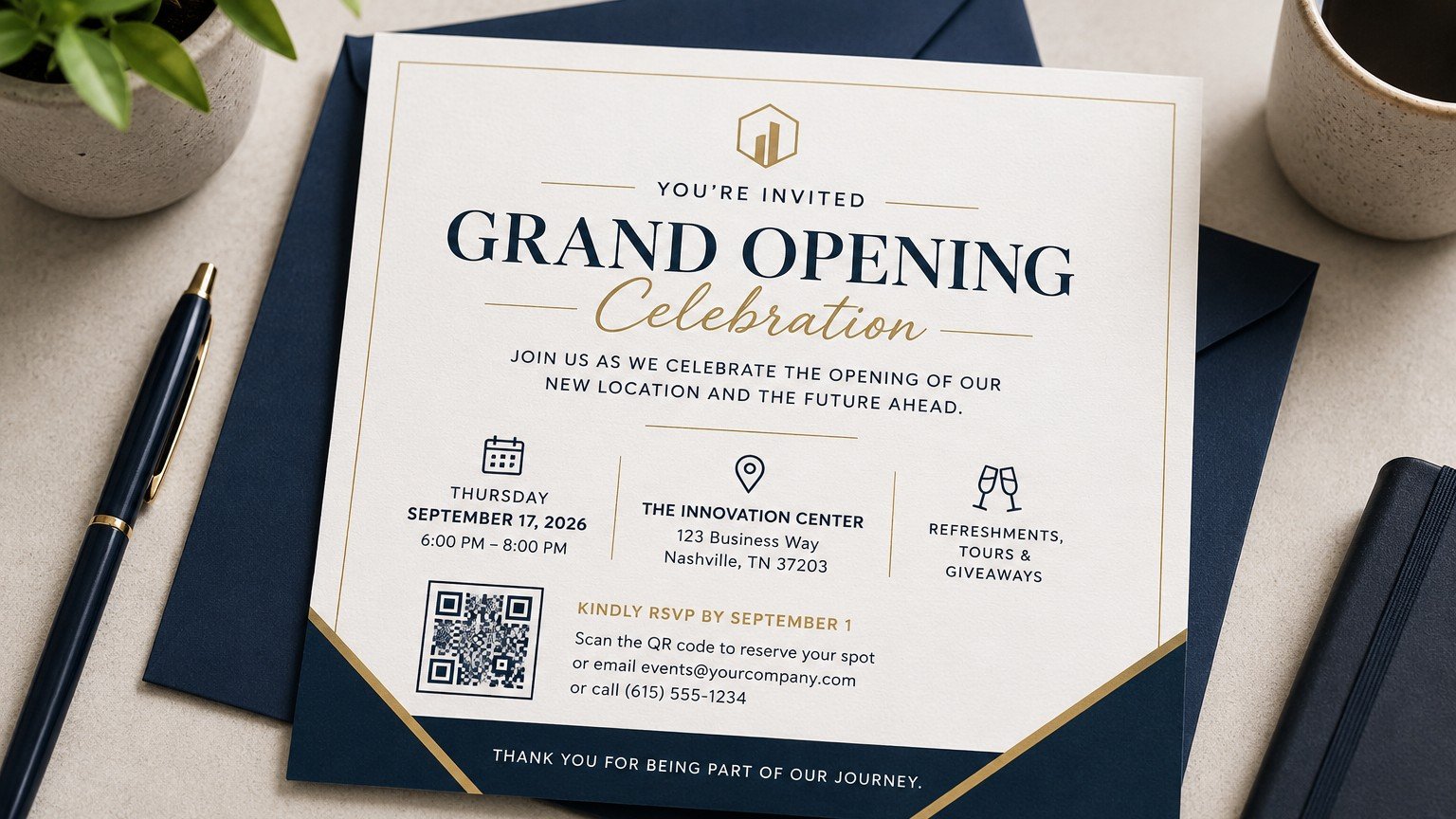
A grand opening invitation should feel energetic, clear, and local. It needs to tell people what is opening, why they should care, when to arrive, and whether there will be a formal ribbon cutting, refreshments, tours, giveaways, or special guests.
A printed invitation works well here because it can be handed to neighboring businesses, mailed to local leaders, included in partner packets, or used as part of a launch campaign.
Fundraisers and Charity Events
Fundraiser invitations need to do two things at once. They need to look credible, and they need to make the purpose of the event obvious.
For charity dinners, auctions, donor nights, and nonprofit galas, paper quality matters more than people expect. A flimsy invitation can make the event feel less established. A clear, well-printed card on a better stock can help signal that the event is organized, thoughtful, and worth attending.
VIP Client Events
Client appreciation events, private previews, soft launches, and invite-only shopping nights all benefit from a physical invitation. The goal is not just information. It is status.
If you want someone to feel personally invited, a printed card does that better than a mass email with a first-name merge tag doing its best.
Corporate Anniversaries and Milestones
A company anniversary, awards night, expansion announcement, or major milestone can use a printed invitation to frame the event as more than internal news. This is especially useful when guests include customers, vendors, investors, city officials, press, or long-time supporters.
Open Houses and Facility Tours
Open houses need practical clarity. Where should people park? What time should they arrive? Is it a drop-in event or a scheduled program? Is there a check-in table? Can guests bring someone?
A printed invitation can help answer the basics before guests start texting someone in your office from the parking lot.
What to Include on a Business Event Invitation
A business event invitation should be good-looking, yes. But it should also behave. If people cannot quickly find the time, place, and RSVP instructions, the design has failed no matter how tasteful the typography is.
Include the following:
Event Name
Make the event name clear and specific. “Grand Opening Celebration” is better than “You’re Invited” by itself. “2026 Donor Appreciation Dinner” is better than “An Evening With Us,” unless your brand is mysterious on purpose.
Host or Company Name
Your logo can do some of the work, but the host should still be obvious. This matters when the invitation gets passed around internally or lands on someone’s desk without context.
Date and Time
Include the day of the week, the date, start time, and end time if it matters.
For example:
Thursday, September 17, 2026
6:00 p.m. to 8:00 p.m.
An end time is especially helpful for networking events, open houses, and business receptions where guests may be deciding whether they can fit it into a packed day.
Venue Name and Address
Do not assume people know where your venue is. Include the venue name, street address, city, and state. If parking is weird, say so somewhere. Guests love elegance, but they love knowing where to park even more.
RSVP Instructions
Make the RSVP method painfully clear. Include one primary action, such as:
RSVP by September 1
Email events@yourcompany.com
Scan the QR code to reserve your spot
Register at the event page
Avoid giving four different RSVP options unless you enjoy sorting chaos.
Dress Code or Event Tone
If the event has a dress code, include it. But keep it normal. “Business cocktail,” “business casual,” “black tie optional,” or “casual open house” are more useful than invented phrases that make guests wonder whether they need a blazer or hiking boots.
Important Logistics
Depending on the event, you may need to include:
- parking details
- check-in instructions
- guest policy
- ticket or donation information
- sponsor names
- speaker or honoree names
- event website
- QR code
- accessibility notes
- meal or reception details
If the list gets long, use the back of the card or a small details card. Do not punish the main invitation for having ambition.
Choose the Right Invitation Format
The format should match the event. Not every business event needs a folded card, foil, and a dramatic envelope. Sometimes a clean 5 x 7 flat card does the job better.
5 x 7 Flat Invitations
This is the safest format for most business events. It has enough room for the event name, host, date, location, RSVP details, and a small amount of supporting copy. It also feels familiar in the hand and works well for mailing.
Use 5 x 7 for:
- grand openings
- fundraisers
- donor events
- VIP client nights
- corporate anniversaries
- open houses
- formal receptions
4 x 6 Invitations
A 4 x 6 card works best for simpler, more casual events. It is compact, affordable, and easy to hand out. The tradeoff is space. If your event needs parking notes, sponsor logos, and three paragraphs of explanation, 4 x 6 will start sweating.
Use 4 x 6 for:
- small customer events
- casual open houses
- in-store events
- short announcements
- hand-delivered invites
4 x 8 Rack-Style Invitations
A tall card can feel modern and promotional. It works well when the design has a strong vertical layout, a bold image, or a schedule-like structure.
Use 4 x 8 for:
- product launches
- ticket-style events
- speaker events
- tours
- creative industry events
Folded Invitations
Folded invitations give you more room, but they also feel more formal. They are best when the event has a program, story, speaker lineup, menu, or sponsor recognition that deserves space.
Use folded invitations for:
- galas
- award ceremonies
- formal dinners
- major fundraisers
- premium sponsor events
Paper and Finish Choices That Feel Professional
Paper and finish should support the event, not hijack it. A business invitation should feel polished, not like it is trying to win a stationery pageant.
Smooth Cardstock
Smooth cardstock is a strong choice for modern business invitations. It keeps logos, photos, and small type crisp. If your design has clean lines, brand colors, or a lot of information, smooth paper is usually the safe starting point.
Matte or Satin Finish
Matte and satin finishes are practical for business events because they look refined without too much glare. They also tend to photograph well and keep text readable.
A glossy finish can work for bright, high-energy events, but use it carefully. Gloss can make a card feel more promotional, which is fine for some events and wrong for others.
Felt, Eggshell, or Textured Stocks
Textured paper can make an invitation feel more premium. It works especially well for nonprofit events, donor receptions, art openings, hospitality events, and formal business dinners.
The caution: texture can soften tiny type and detailed artwork. If your invitation uses a small sponsor logo wall, a textured stock may not be your best friend.
Pearlescent or Specialty Stocks
Pearlescent paper can look great for evening events, galas, and more polished celebrations. It adds a subtle shine without needing foil everywhere.
Just make sure it fits your brand. A pearlescent invite for a luxury hotel event? Good. A pearlescent invite for a forklift equipment demo? Maybe not. Though honestly, that would be memorable.
Foil Accents
Foil can work beautifully on business event invitations when used with restraint. A small foiled logo, event title, border, or VIP-style accent can elevate the piece without making it feel overdone.
Foil is strongest for:
- galas
- awards nights
- premium product launches
- donor events
- formal anniversary celebrations
- luxury retail events
If the event is casual or operational, spend the money on better paper, clearer design, or mailing instead.
Rounded Corners
Rounded corners can make a card feel more modern and finished. They are especially useful for tech events, creative launches, ticket-style invitations, and open house invites.
They are not required. But they can be a nice touch when the design already leans clean and contemporary.
Design Tips for Professional Business Invitations
Business event invitations should be branded, but not buried in branding. There is a difference between “this feels like our company” and “someone pasted the brand guideline PDF onto a postcard.”
Use One Clear Visual Hierarchy
The guest should understand the invitation in this order:
- what the event is
- who is hosting it
- when it happens
- where it happens
- how to RSVP
That is the order. Not sponsor logos first. Not a paragraph about your company’s journey. Not the QR code doing a heroic amount of visual labor.
Keep the Logo Present, Not Loud
Your logo should be visible, but it does not need to dominate the card. A business invitation is not a trade show banner. Let the event title carry the top position unless the brand itself is the main reason people are attending.
Use Brand Colors Carefully
Brand colors help the invitation feel connected to your company. But if your brand palette is intense, use the stronger colors as accents. A full-card background in the wrong corporate blue can turn elegant into office-supply-folder very quickly.
Write Like a Human
Business invitations often get too stiff. You do not need to sound like a legal notice.
Instead of:
The executive team cordially requests the pleasure of your attendance at a commemorative corporate occasion.
Try:
Please join us for an evening celebrating our new showroom opening.
Clear wins. Always.
Add a QR Code Only If It Helps
A QR code is useful for registration, maps, ticketing, or event details. It is not useful if it sends people to a homepage where they have to hunt for the event.
If you use a QR code, include a short written backup like “RSVP online” or “View event details.” Some people still prefer typing a URL, and some phones choose inconvenient moments to be dramatic.
When to Send Printed Business Event Invitations
Timing depends on the event type and the guest list. The more formal, expensive, or travel-heavy the event is, the earlier the invitation should go out.
A practical starting point:
- Grand openings and ribbon cuttings: 4 to 6 weeks before the event
- Corporate anniversaries and milestone events: 4 to 6 weeks before the event
- Fundraisers, galas, and ticketed events: 6 to 8 weeks before the event
- Networking events and luncheons: 3 to 4 weeks before the event
- VIP client events: 4 to 6 weeks before the event
- Open houses: 3 to 5 weeks before the event
For mailed invitations, remember that printing time and shipping time are separate. So is the time your team spends approving the proof, stuffing envelopes, fixing the mailing list, and realizing that someone spelled the keynote speaker’s last name wrong.
Build in a buffer. Future you will be less cranky.
Why PrintInvitations Is a Strong Fit
PrintInvitations makes sense for custom printed invitations for business events because the process is built around the parts that actually matter: clean printing, paper and finish choices, personalization, digital proofs, and fast production.
The biggest advantage is the proof-first workflow. For business events, proofing is not just nice. It is risk control. A typo on a wedding invitation is stressful. A typo on a corporate invite going to sponsors, clients, donors, or city officials is a special kind of awkward.
PrintInvitations lets you start with a template or upload your own design, personalize the wording, review a free digital proof, and then move into production once the details look right.
The site also offers a range of paper and print options, including smooth, felt, eggshell, pearlescent, natural, UV matte, UV gloss, satin, and foil choices. That gives businesses enough flexibility to match the event tone without getting trapped in an endless menu of novelty finishes.
Turnaround is another reason to consider it. Most orders are produced in 3 business days or less, with several shipping options available. That matters for business events because timelines are rarely as calm as they look in the first planning meeting.
The best fit is probably a business, nonprofit, agency, venue, or event planner that wants invitations that feel more polished than a bargain office-store print, but does not need full bespoke stationery pricing.
Common Mistakes to Avoid
Treating the Invitation Like a Flyer
A flyer sells. An invitation invites. It can still promote the event, but the tone should feel more personal and selective.
Do not cram every sponsor, benefit, speaker bio, menu item, parking note, and brand value onto the front of the card. Use hierarchy. Use the back. Use a details card. Use the website. Use restraint, which is apparently free but underused.
Forgetting the RSVP Deadline
An invitation without a clear RSVP deadline creates planning problems. Food counts, seating, staffing, printed programs, security lists, and name tags all depend on knowing who is coming.
Add the deadline. Make it visible.
Choosing Paper Last
Paper affects how the invitation feels before anyone reads it. If the event is important, do not treat paper as a checkout afterthought. Pick a stock and finish that match the tone.
Making the QR Code Too Small
If the QR code is important, it needs enough space and contrast to scan easily. Do not hide it in a corner like it owes someone money.
Ignoring Mailing Time
Even fast printing does not make the postal system teleport. If the invitation needs to be mailed, plan backward from the event date and include production, proof approval, shipping to you, assembly, mailing, and delivery.
Quick Checklist Before You Print
Before approving your business event invitations, check these items:
- Event name is clear
- Host or company name is obvious
- Date includes the day of the week
- Start time is easy to find
- End time is included if useful
- Venue name and full address are correct
- RSVP method is clear
- RSVP deadline is included
- Dress code or event tone is listed if needed
- Parking or check-in notes are included if relevant
- QR code scans correctly
- Sponsor logos are not blurry
- Brand colors look right
- Paper and finish match the event
- Mailing timeline has enough buffer
- Someone outside the planning team has proofread it
That last one matters. People who have stared at the same invitation for six days stop seeing mistakes. The brain is helpful like that, which is to say not always helpful at all.
Final Recommendation
Custom printed invitations for business events are worth using when the event needs to feel intentional, credible, and worth attending. They are especially strong for grand openings, donor events, formal receptions, client appreciation nights, VIP launches, corporate anniversaries, and local business milestones.
Keep the design clear. Choose paper that matches the tone. Give guests one obvious RSVP path. Build in enough time for proofing, printing, shipping, and mailing. And do not let the invitation become a tiny brochure with envelope aspirations.
For most businesses that want a polished printed invite without overcomplicating the order, PrintInvitations is a smart place to start. It gives you the practical pieces that matter most: templates or upload-your-own design, flexible personalization, free digital proofs, strong paper and finish options, and quick production.
That is the sweet spot for business event invitations. Professional, clear, and well printed. Not fussy. Not flimsy. Not another email pretending it has a chance.