
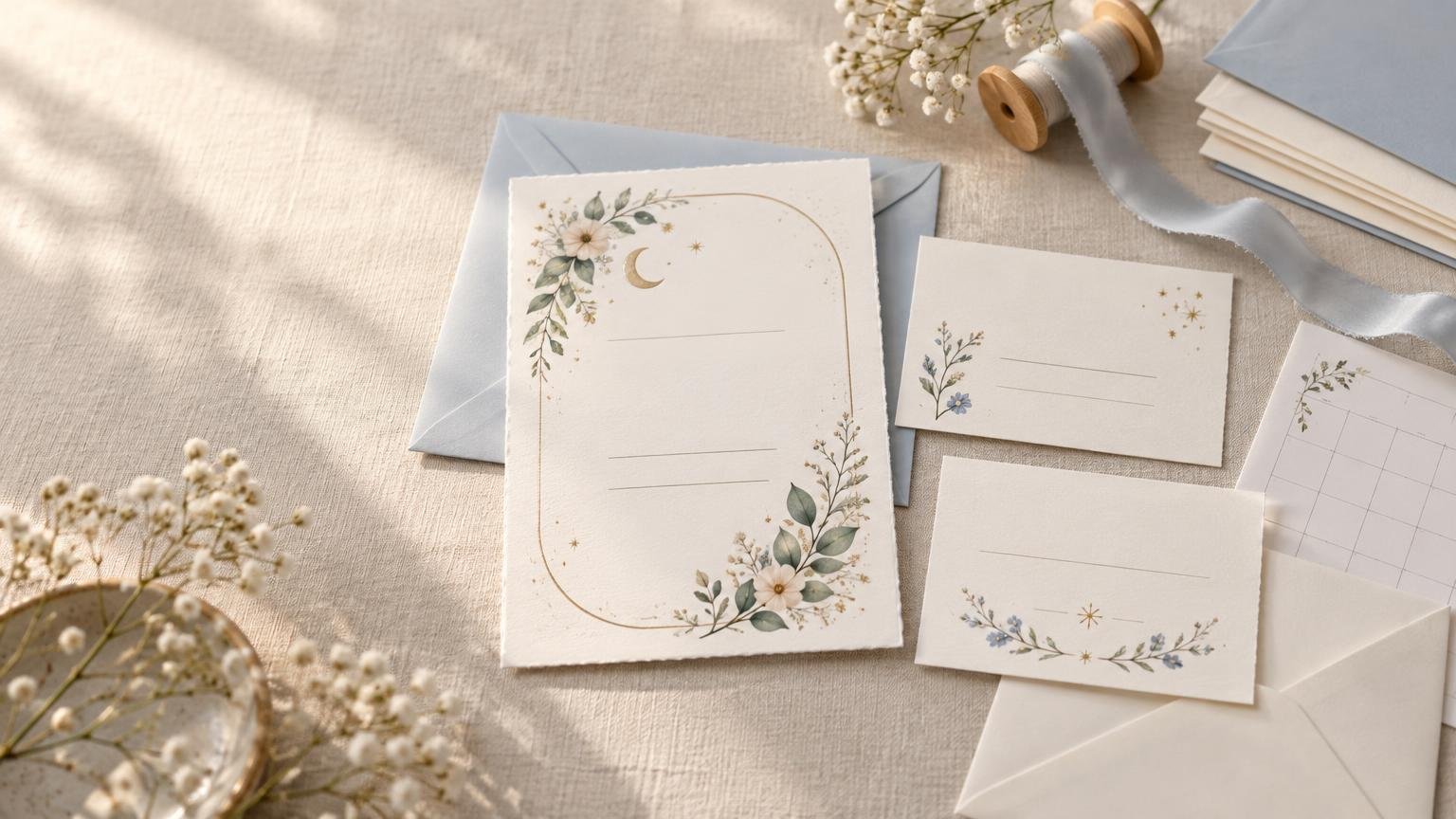
TLDR: For most local events, send printed baby shower invitations four to six weeks before the shower. Choose six weeks when guests may need to travel, the date falls in a busy season, or you want a comfortable response window. Four weeks can work for a simple local gathering, but it leaves less room for delayed replies and follow-up. This is the mailing date, not the date to begin designing or ordering.
The practical answer to when to send baby shower invitations depends on more than etiquette. A printed card must be personalized, proofed, produced, delivered to the host, addressed, assembled, checked for postage, and placed in the mail. Working backward through those steps is safer than choosing a mail date and assuming everything before it will fit.
The standard baby shower invitation timeline
Four to six weeks before the shower is a useful general mailing window. The Bump gives the same central range and notes that earlier notice can help guests manage busy schedules. This is planning guidance rather than a postal guarantee or an inflexible etiquette rule.
| Situation | Practical mailing target | Why |
|---|---|---|
| Mostly local guests and a simple event | About four to five weeks before | Usually provides a reasonable response window without making guests hold the details for months. |
| Traveling guests or a calendar-crowded date | About six weeks before | Gives guests more time to coordinate travel, childcare, work, or other commitments. |
| Baby sprinkle | Around one month before | A smaller, more casual gathering may need less lead time, though travel and scheduling can still justify sending earlier. |
| Short-notice shower | As soon as the essentials are confirmed | Send the printed invitations promptly and consider a direct digital heads-up so guests do not lose more planning time. |
Avoid mailing much earlier solely because the invitations are finished. Details are easier to misplace or forget when an invitation arrives far ahead of a relatively informal event. If guests need substantially more notice, a personal message can alert them to reserve the date while the complete printed invitation follows after the venue, time, and RSVP details are settled.
When to order printed baby shower invitations
Your order date must come before your mailing window. Do not count only production time. Build a schedule that includes design decisions, proof corrections, printing, shipping to the person handling the mailing, and hands-on assembly.
PrintInvitations states that production starts after proofing is complete, that most orders are produced within three business days or less, and that most ship within one business day. It also cautions that choosing faster shipping does not shorten production itself. These are current published expectations, not a promise for every order, so verify the applicable turnaround and delivery estimate when ordering.
A sensible workflow is to start the invitation process several weeks before the desired mail date, then adjust for the product, revisions, shipping destination, and complexity of the suite. A straightforward card with one envelope requires less handling than a layered invitation with an insert, envelope liner, return-address printing, or other assembly.
- Choose the target mail date, normally four to six weeks before the shower.
- Reserve time for wording, address collection, design personalization, and any family approvals.
- Submit the order and wait for the digital proof rather than treating checkout as the start of production.
- Review the proof carefully and allow time for corrections if anything is wrong.
- Account for production and shipping to the host or person mailing the invitations.
- Leave time to address envelopes, assemble the pieces, weigh a finished sample, and obtain the correct postage.
- Mail the invitations with enough time for delivery and guest responses before the RSVP deadline.
This backward-planning method also applies to other formal events, although their timing windows differ. The workflow in this guide to when to order wedding invitations illustrates why proofing, production, shipping, and assembly should be treated as separate stages rather than one vague printing deadline.
Finalize these details before printing
Printing before the event details are stable can turn a small scheduling change into a full reprint. At minimum, settle the date, start time, location, host or RSVP contact, and reply method. The invitation may also need registry information, a theme or dress code, and a note about any activity that requires guests to bring or prepare something. The Bump’s planning checklist likewise identifies the date, time, location, RSVP information, theme or dress code, and registry details as relevant invitation information.
- The honoree’s name and the type of celebration
- The calendar date and correct day of the week
- The start time and, if needed, an end time
- The venue name and complete street address
- The RSVP contact, reply method, and deadline
- Registry information or a short direction to where guests can find it
- Theme, dress code, book request, diaper raffle, or other special instructions
- Accessibility, parking, entrance, or virtual-attendance details when guests need them
Complete the registry before printing a registry link or note. If the registry may change, direct guests to a stable event page rather than crowding the card with multiple store names and long web addresses. Clarity matters more than fitting every planning detail onto the invitation.
Set the RSVP deadline from the host’s real deadline
There is no single RSVP date that fits every baby shower. Start with the date when the host must give a final count to the venue, caterer, baker, rental company, or activity provider. Put the invitation deadline before that date, leaving enough time to contact people who have not replied and update the count.
For a casual shower at home, the host may have more flexibility. A catered luncheon, reserved venue, personalized favors, or seated activity can require an earlier count. The RSVP deadline should serve the host’s purchasing and setup decisions, not simply look tidy on the card.
Proof the invitation as a physical communication piece
PrintInvitations states that orders include a free digital proof before production, with physical proofs and samples available for a fee. Its proofing guidance recommends checking names, the date and day of the week, time, venue or address, RSVP details, punctuation, layout, and readability.
Read the proof slowly instead of checking only whether the design looks attractive. Verify the date against a calendar, search the venue address independently, and test any QR code or typed web address. Ask another person to proofread the final version without first telling them what it is supposed to say; familiarity can make errors surprisingly easy to overlook.
- Confirm spelling, capitalization, punctuation, and name order.
- Match the written day of the week to the numerical date.
- Check whether the time is clearly morning or afternoon.
- Verify the venue name, street number, city, state, and postal code.
- Test the phone number, email address, QR code, or reply link.
- Make sure small text remains readable and is not crowded against the trim edge.
- Review every card and envelope option, not only the main invitation.
- Approve the proof only after all requested corrections appear in the new version.
Custom printing policies make this step especially important. PrintInvitations states that custom orders generally are not returnable or refundable for customer-supplied wording errors, incorrect quantities, or mistakes present in an approved proof. It separately describes review for applicable production, fulfillment, and shipping-damage problems. Check the current policy for the exact order and report a qualifying problem promptly.
Order by households, then add a small buffer
Invitation quantity normally follows mailing addresses, not the total number of guests. A couple or family at one address may receive one invitation, while adults living separately need their own. Build the address list first, count the envelopes, and then add extras.
A modest buffer is useful for addressing mistakes, returned or damaged mail, late additions, keepsakes, and a copy for the honoree. There is no universal extra percentage that suits every list. A small shower may need several extras because even two late additions are significant, while a larger list can be evaluated by the number of uncertain addresses and likely additions. Compare the cost of a few extras in the original order with the cost and delay of a separate reprint.
Check the finished invitation before buying postage
Postage depends on the completed mailpiece, not merely the number of cards inside it. Weight matters, but so do dimensions, thickness, flexibility, shape, and surface features. USPS explains that standard letter pricing applies only when a piece meets its letter-size and shape requirements; square, rigid, or unusually shaped pieces may be nonmachinable. Review the official USPS letter-size guidance before committing to an envelope format.
Assemble one invitation exactly as guests will receive it, including every insert, liner, seal, ribbon, or embellishment. Weigh and measure that finished sample, and take it to a Post Office when there is any uncertainty. Do this before buying stamps in bulk. Postal prices change, so confirm the current amount through USPS rather than relying on a saved rate or an old planning article.
A square envelope or thick layered suite can be attractive, but it may increase mailing cost or handling complexity if the completed piece does not meet machinability requirements. If budget or timing is tight, a conventional rectangular card in a properly sized envelope is usually the simpler format to evaluate.
Common baby shower invitation timing questions
How early should invitations go to out-of-town guests?
Use the earlier end of the four-to-six-week window when guests may travel. If flights, hotels, or complicated schedules are likely, give key guests an informal heads-up as soon as the date is dependable. The printed invitation can follow once the complete event information is ready.
When should baby sprinkle invitations be mailed?
About one month before is a reasonable starting point for a local, casual sprinkle, consistent with The Bump’s shorthand guidance. Move closer to six weeks when guests must travel or the date competes with holidays, school breaks, or other busy periods.
Can a digital reminder supplement printed invitations?
Yes. A brief reminder can help shortly before the RSVP deadline or when the event is approaching. It should reinforce the printed invitation rather than introduce changed details without explanation. If the time or location changes, contact every invited household directly and ask for confirmation that the update was received.
What if the shower is being planned on short notice?
Send invitations as soon as the core details are confirmed and notify guests through a faster channel at the same time. Keep the printed format straightforward, verify the printer’s current production and shipping estimates, and avoid specialty assembly choices that create unnecessary steps. Do not assume expedited shipping will also expedite proofing or production.
The safest next step
Choose your target mail date first: roughly six weeks before the shower when guests need more planning time, or four to five weeks before a simpler local event. Then work backward through proofing, production, delivery, addressing, assembly, and postage verification. Before approving the final invitation, confirm the calendar date, venue address, RSVP method, and every element of a fully assembled mail sample. That sequence is what keeps a comfortable four-to-six-week plan from becoming a last-minute mailing problem.