
TLDR
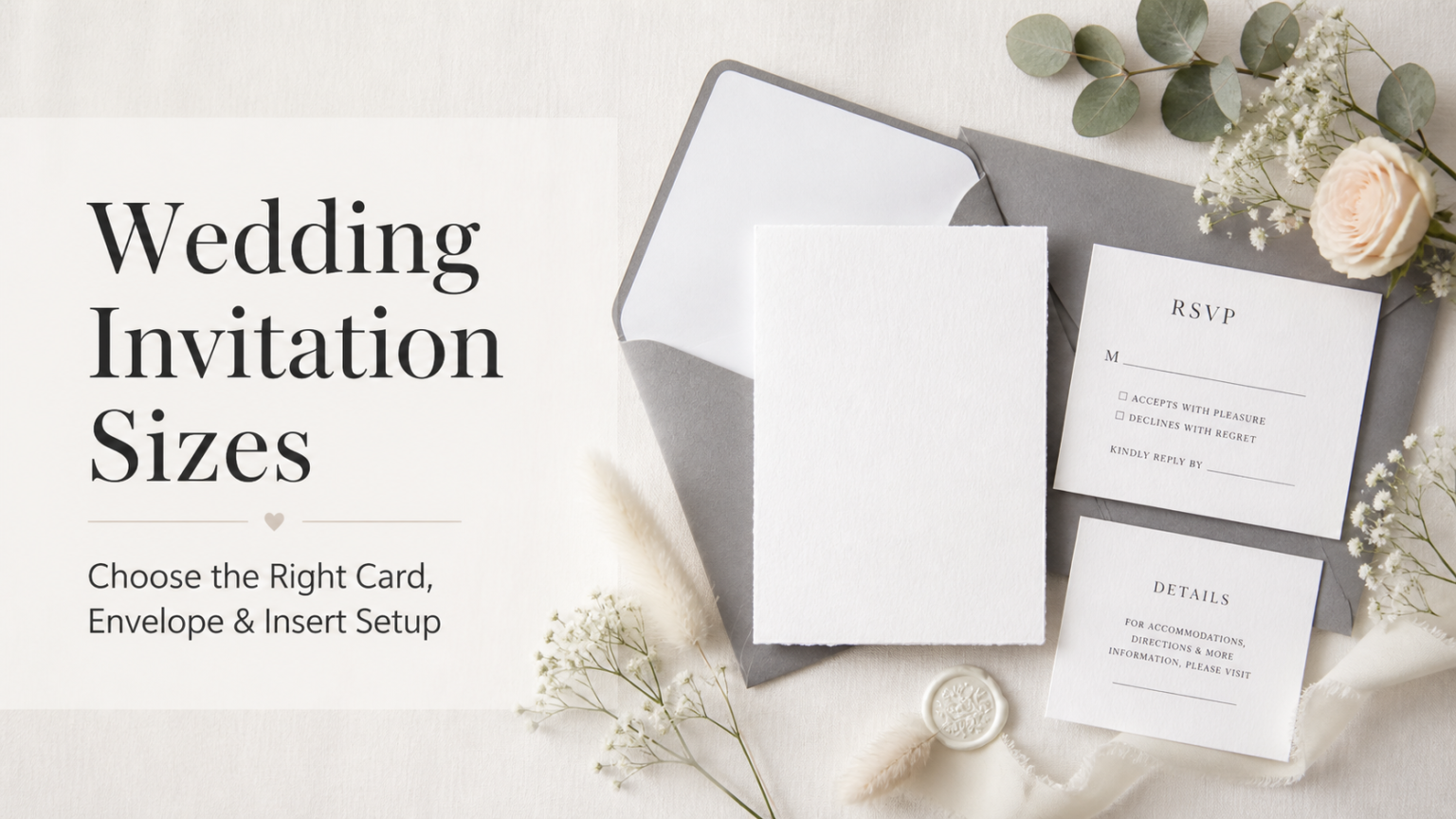
Most couples should start with a 5×7 wedding invitation in an A7 envelope. It gives you enough room for names, date, venue, and design without making the suite awkward to mail.
Your RSVP card and details card should be smaller than the main invitation so the full wedding invitation suite stacks cleanly. Size also affects postage, especially if you choose square invitations, thick cardstock, rigid inserts, wax seals, or unusual envelope shapes.
The Simple Answer: 5×7 Is The Safest Starting Point
Wedding invitation sizes can feel more complicated than they need to be. There are square cards, petite cards, oversized cards, folded cards, RSVP cards, details cards, belly bands, liners, and envelopes that all need to work together. But for most couples, the simplest answer is still the best one: start with a 5×7 wedding invitation.
A 5×7 card gives you enough room for the couple’s names, wedding date, ceremony time, venue, city, and a little design breathing room. It also fits a standard A7 envelope, which makes the whole setup easier to assemble, address, and mail.
That matters because your invitation is not just a pretty card. It is the anchor of the full wedding invitation suite. The main card sets the size, and every other piece works around it. If the main card is too small, the wording can feel cramped. If it is too large, the envelope, insert stack, and postage can get more complicated.
So unless you have a strong design reason to do something different, 5×7 is the best starting point. It looks polished, feels familiar to guests, and gives your printer a practical format to work with.
You can still make it feel personal with paper, color, typography, foil, finish, and matching enclosure cards. The size does not have to do all the work.
Common Wedding Invitation Sizes And Envelope Fits
The main invitation should usually be the largest flat card in the suite. The envelope should fit that largest piece with enough room to slide everything in without bending corners or leaving too much empty space.
Here are the common formats couples usually consider:
| Invitation Piece | Common Size | Common Envelope Fit | Best For |
|---|---|---|---|
| Main Invitation | 5×7 inches | A7 envelope, usually 5.25×7.25 inches | Most traditional and modern wedding invitations |
| RSVP Card | 4.25×5.5 inches | A2 envelope, usually 4.375×5.75 inches | Mailed response cards |
| Details Card | 4×6 or 4.25×5.5 inches | Usually stacked inside the main A7 envelope | Travel, website, reception, and hotel information |
| Petite Invitation | Around 4.25×6 inches | Smaller envelope format | Simple weddings, short wording, minimal designs |
| Square Invitation | Commonly 5×5 or 6×6 inches | Square envelope | Bold design statement, but often less mail-friendly |
| Oversized Invitation | 6×8 inches or larger | Larger envelope | Formal suites, dramatic layouts, more space |
| Folded Invitation | Varies by folded size | Envelope based on folded dimensions | More copy, photos, or all-in-one layouts |
The important part is not memorizing every size. It is knowing the relationship between the pieces.
A 5×7 main card normally pairs with an A7 envelope. RSVP cards are smaller and often use A2 envelopes when guests mail them back. Details cards and other enclosure cards usually sit behind the main invitation inside the outer envelope.
That size hierarchy helps the suite feel intentional. The main invitation leads. The RSVP and details cards support it.
How RSVP Cards And Details Cards Should Fit The Main Invitation
The main invitation should feel like the main event. RSVP cards and details cards should be smaller, easier to scan, and clearly connected to the design.
A common RSVP card size is 4.25×5.5 inches. That gives you room for the reply deadline, guest name line, attendance options, meal choices if needed, and a small design element. If guests are mailing the RSVP back, it should fit a return envelope cleanly.
A details card can be similar in size, but the best size depends on how much information you need to include. A short wedding website note might work on a small enclosure card. A full travel card with hotel blocks, shuttle notes, parking instructions, and weekend timing may need more space.
A good rule: do not make the insert card small just because it looks cute. Small cards can feel polished, but only if the text stays readable.
Details cards are especially helpful because they keep the main invitation clean. Your Wedding Invitations should usually focus on the core event. Your RSVP Cards and Details Cards can handle the response method, hotel notes, dress code, reception details, transportation, and wedding website.
That separation makes the whole suite easier for guests to understand.
When Square, Oversized, Or Folded Invitations Are Worth It
Not every couple needs the safest format. Sometimes a less standard size is the right choice.
Square invitations can look stylish and balanced, especially with centered typography, monograms, floral borders, or modern minimalist layouts. They feel distinct right away. The tradeoff is mailing. Square mail can be treated differently by USPS, so it is smart to assume extra postage or special handling may be involved.
Oversized invitations can work well for formal weddings, black-tie events, destination weekends, or designs that need more room. A larger card gives the design more presence. It can also make heavier paper feel more substantial. But oversized suites may require larger envelopes, more paper, and more careful postage planning.
Folded invitations are useful when you want more information in one piece. They can work for illustrated maps, weekend schedules, photo layouts, or all-in-one invitation formats. The tradeoff is thickness and folding accuracy. A folded piece has to close cleanly, fit the envelope, and avoid feeling bulky once inserts are added.
These choices are not wrong. They just come with more practical checks.
Choose a non-standard format when the size supports the design or guest experience. Do not choose it just because it looks different in a template preview.
How Size Can Affect Postage And Handling
Postage is where invitation size gets practical very quickly.
A flat, rectangular invitation suite is usually the easiest to mail. A square, rigid, thick, or unusually shaped suite may need extra postage or special handling. USPS notes that square, rigid, or unusually shaped mail can be subject to higher prices because it may require manual processing.
Size is only one factor. Weight matters too. So does stiffness. So do outside decorations.
Common details that can affect mailing include:
- square envelopes
- thick cardstock
- multiple enclosure cards
- RSVP envelopes
- envelope liners
- wax seals
- ribbon or twine
- pocket folds
- layered cards
- rigid inserts
A 5×7 invitation with a simple RSVP card and a details card may mail very differently than a thick formal suite with a liner, double envelope, wax seal, and several enclosure cards.
That is why the best postage advice is simple: assemble one complete invitation exactly as you plan to mail it, then take it to the post office before stamping the full batch.
Use the real main card, real RSVP card, real return envelope, real details card, real outer envelope, and any liner or seal. Ask whether it qualifies as standard letter mail, whether it is machinable, and what postage it needs.
For more detail, read Wedding Invitation Postage Explained before mailing.
Paper Weight, Bleed, And Trim Still Matter
Invitation dimensions are only part of the setup. The paper and print specs matter too.
A heavier cardstock can make a wedding invitation feel more substantial. It can also increase the total weight and stiffness of the finished mailing. That does not mean you should avoid heavier paper. It just means paper weight is part of the mailing decision, not only the design decision.
The same is true for finish. Matte, gloss, satin, pearlescent, textured, and foil options can all change how the invitation feels in hand. PrintInvitations’ Paper & Print Options page is a good place to compare how stock and finish affect the final piece.
Bleed and trim are the print side of the size conversation.
Trim is the final cut size of the card. A 5×7 invitation is 5×7 after trimming. Bleed is the extra artwork area that extends beyond the trim edge so background colors, photos, or patterns can print cleanly to the edge.
If your design has a full background, border, photo, or color block that reaches the edge, make sure the file is built with the correct bleed. Do not place important text too close to the trim line. A tiny movement in cutting is normal in print, and good spacing keeps the final card looking intentional.
The practical version: use the printer’s template, keep important text inside the safe area, and extend edge-to-edge artwork past the trim line.
A Quick Wedding Invitation Size Checklist
Before choosing your final invitation size, run through this checklist:
- Start with 5×7 unless you have a clear reason to choose another size.
- Pair a 5×7 invitation with an A7 envelope.
- Keep RSVP cards and details cards smaller than the main invitation.
- Make sure every insert fits easily inside the outer envelope.
- Leave enough room for readable text, especially on RSVP and details cards.
- Use smaller enclosure cards only when the wording is short.
- Choose square invitations for style, but plan for possible postage changes.
- Choose oversized invitations only if the design needs the space.
- Check paper weight and finish before assuming postage.
- Build files with proper bleed and trim settings.
- Assemble and weigh a finished sample before mailing the full batch.
That last step is the one people skip. It is also the one that prevents the most expensive surprises.
FAQs
What Is The Most Common Wedding Invitation Size?
The most common wedding invitation size is 5×7 inches. It is popular because it gives enough room for the main wedding details and fits a standard A7 envelope.
What Size Envelope Fits A 5×7 Wedding Invitation?
A 5×7 wedding invitation usually fits an A7 envelope. A common A7 envelope size is 5.25×7.25 inches, giving the card enough room to slide in cleanly.
What Size Should RSVP Cards Be?
A common RSVP card size is 4.25×5.5 inches. This size gives enough room for reply wording, guest names, attendance choices, and meal selections while staying smaller than the main invitation.
Do Square Wedding Invitations Cost More To Mail?
They can. Square mail can require extra postage or special handling because it may not process like a standard rectangular letter. Always test a finished sample with the post office before mailing the full batch.
Should Details Cards Match The Main Invitation Size?
Usually no. Details cards should match the design style, but they are often smaller than the main invitation. That helps the suite stack cleanly and keeps the main card as the visual anchor.
Can Thick Cardstock Change Postage?
Yes. Thick cardstock can affect both weight and stiffness. A heavier suite may need additional postage, and a rigid suite may be handled differently than a flexible letter.