
Last updated: August 18, 2026
The Fiery N-70 is supposed to be the serious controller for the Ricoh Pro C9500. Fiery explicitly positions it for high-volume production. The C9500 itself is a flagship production press capable of running at up to 135 pages per minute.
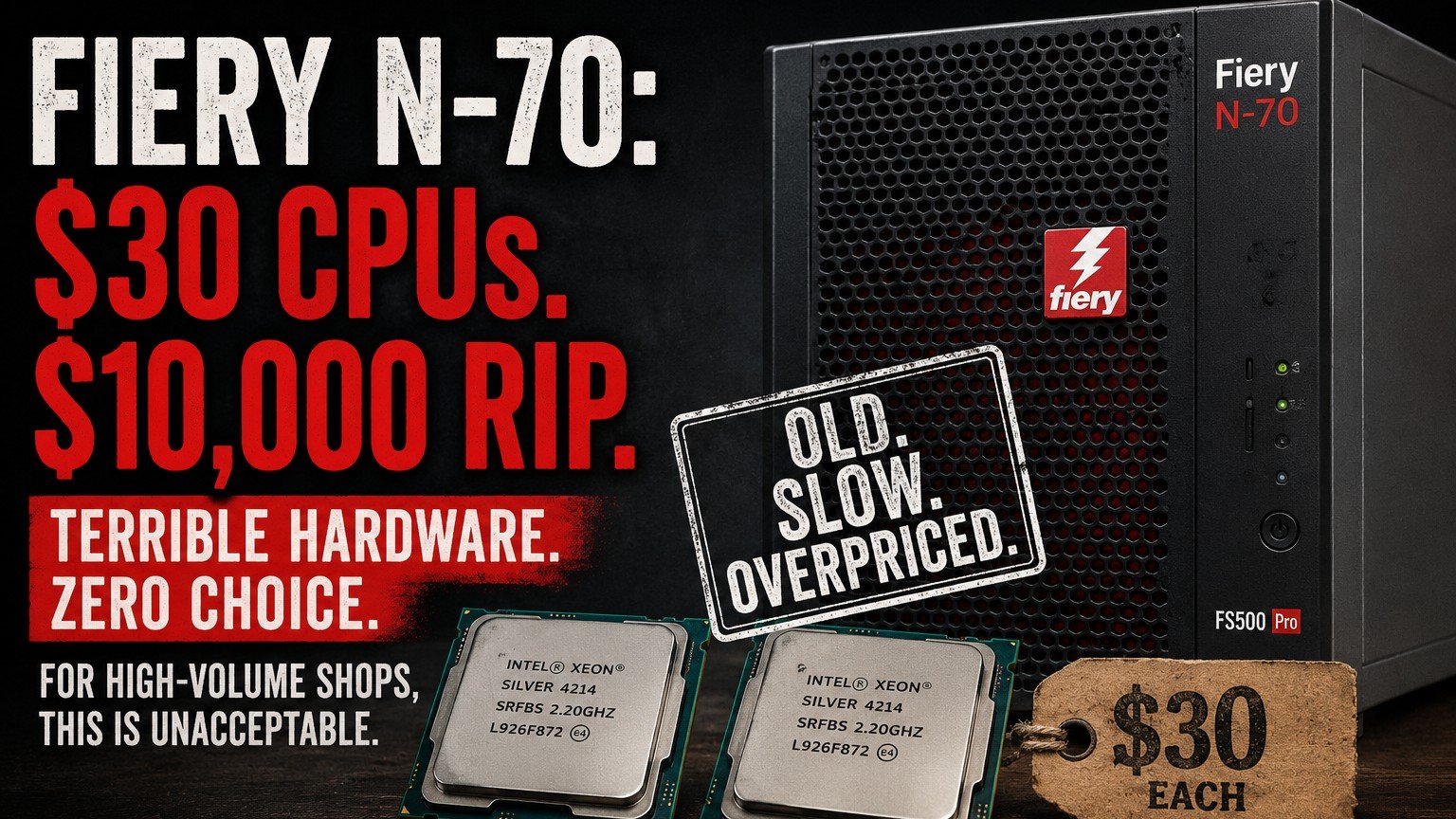
And the computer Fiery gives you to feed that machine uses a pair of Intel Xeon Silver 4214 processors from 2019.
Those processors currently sell used for roughly $30 apiece.
No, that is not a typo.
The supposedly premium digital front end attached to a modern production press is built around processors that have depreciated to roughly the price of dinner.
The problem is not simply that the Fiery N-70 uses old hardware. Industrial equipment often uses mature components for stability. The problem is that Fiery combines old hardware, mediocre performance, mechanical hard drives, limited RAM, premium pricing, proprietary software, and a closed hardware ecosystem that prevents high-volume print shops from simply replacing the computer with something faster.
That is an awful value proposition.
And if you actually run a busy production shop, it can become an operational problem rather than merely an offensive spec sheet.
The Fiery N-70 Hardware Is Embarrassing in 2026
Here is the actual Ricoh Pro C9500 N-70 configuration:
- Two Intel Xeon Silver 4214 processors
- 32 GB RAM
- 480 GB SATA SSD for the operating system
- Two 2 TB SATA hard drives for data
- Windows 10 IoT Enterprise 2019 LTSC
- Fiery FS500 Pro
That’s the premium option.
Intel launched the Xeon Silver 4214 in the second quarter of 2019.
It is a 12-core, 24-thread Cascade Lake server processor running at a 2.2 GHz base clock with a maximum turbo frequency of 3.2 GHz. It uses 14 nm manufacturing technology, DDR4-2400 memory, and PCIe 3.0.
This was legitimate server hardware when it launched.
In 2019.
Intel originally listed the processor at roughly $780 to $791.
Today, used Xeon Silver 4214 processors can be found around the $30 mark. One current listing we checked was $30.25, with more than ten available. Other listings have appeared in roughly the $20 to $50 range.
That means the pair of CPUs at the heart of the N-70 can now have a used-market value of roughly $60 total.
Fiery’s “high-volume production” controller is powered by processors that server recyclers are practically giving away.
Wonderful.
This Would Be Funny If the N-70 Were Fast
Old hardware isn’t automatically bad hardware.
If the N-70 screamed through complicated production files, nobody would care what year the processors came out.
But that’s the problem.
In a genuinely high-volume shop, the Fiery N-70 can still feel painfully slow.
We aren’t talking about opening Gmail or waiting for an Excel spreadsheet.
This machine has one job: process print work.
Production shops throw large imposed PDFs, complicated transparency, variable data, image-heavy artwork, large quantities of short-run jobs, repeated reprints, multiple queues, finishing instructions, color processing, and constant simultaneous production at these systems.
RIP speed matters.
Queue responsiveness matters.
Job processing matters.
Storage speed matters.
Waiting for files to process while a production press is capable of outputting more than two sheets every second matters.
A slow workstation is annoying.
A slow RIP attached to an expensive production press can reduce the utilization of the press itself.
That costs money.
Fiery Calls This a High-Volume Production Controller
This is what makes the specifications especially hard to swallow.
Fiery doesn’t market the N-70 as some inexpensive entry-level controller for a copy shop running fifty brochures before lunch.
Fiery specifically says the N-70 is targeted to high-volume production environments.
Exactly.
So why are we feeding a high-volume production environment with hardware from 2019?
Why does the machine have only 32 GB of RAM?
Why are the primary data drives two mechanical SATA hard drives?
Why does the operating system live on a 480 GB SATA SSD?
Why isn’t there an NVMe scratch array?
Why isn’t there 128 GB of RAM?
Why isn’t there a modern high-clock processor architecture?
And most importantly, why can’t the customer decide how much processing power the customer needs?
The $30 CPU Isn’t Really the Scandal
The used processor price makes for a great headline, but it isn’t actually the biggest problem.
Server processors depreciate brutally. That’s normal.
The Xeon Silver 4214 wasn’t a $30 processor when Fiery designed the N-70. Intel originally priced it around $780.
The real scandal is how little control the customer has over the hardware today.
If I could buy Fiery software and install it on my own qualified workstation, I wouldn’t care what components Fiery happened to use in its appliance.
Give me minimum requirements.
Give me a certified hardware list.
Charge me for the RIP.
Then get out of the way.
A serious high-volume print shop could build a workstation with a modern CPU, 128 GB of RAM, several terabytes of fast NVMe storage, and enough processing headroom to keep a production press busy.
Instead, Fiery sells you a box.
And if the box isn’t fast enough, you don’t get to build a faster one.
That’s the part that is indefensible.
You Can’t Just Build a Better Fiery
This is where Fiery’s hardware model crosses from annoying into infuriating.
Ordinary software gives the customer a performance ladder.
Adobe software running slowly? Buy a faster workstation.
Your rendering system is overwhelmed? Add RAM.
Your scratch disk is saturated? Install more NVMe storage.
Your server workload has increased? Upgrade the server.
This is normal computing.
With Fiery, the hardware and software are bound together as an appliance.
For the Ricoh C9500, Ricoh lists the N-50 and N-70 as the Fiery controller choices.
You cannot simply tell Fiery:
“My workload has doubled. I want to move this installation to a modern 64-core workstation with 256 GB RAM.”
That would be far too reasonable.
Instead, the processing hardware becomes another fixed part of the print ecosystem, even though computer performance advances much faster than production press technology.
The C9500 itself may remain productive for years.
The computer architecture attached to it keeps getting older every day.
The N-50 Makes the Situation Look Even Worse
If the N-70 is disappointing, the N-50 is almost insulting.
The N-50 uses:
- Intel Core i5-8500
- 8 GB RAM
- 256 GB SATA SSD
- 1 TB SATA hard drive
The i5-8500 launched in early 2018.
It is a six-core, six-thread consumer desktop processor.
Eight gigabytes of RAM was stingy for a normal workstation when the C9500 launched. Putting it in a production DFE attached to a flagship commercial press is almost parody.
Fiery effectively gives Ricoh customers a choice between:
The obviously underpowered Fiery
and
The less underpowered Fiery
For a low-volume operation processing straightforward files, perhaps that’s enough.
For a serious production shop, “enough” is not the standard.
The controller should be difficult for the workload to overwhelm.
Instead, high-volume operators can end up planning around the limitations of the computer attached to the press.
32 GB of RAM Is Not Impressive
The N-70 has four times as much memory as the N-50.
That sounds good until you realize the N-50 starts at 8 GB.
Thirty-two gigabytes in a production server isn’t an impressive amount of memory in 2026.
It is ordinary workstation memory.
Fiery’s own sales pitch emphasizes HyperRIP, simultaneous job processing, complex file processing, automation, imposition, color processing, and high-volume production.
Those are exactly the workloads where additional memory and fast storage can become useful.
Yet we’re supposed to look at 32 GB and say, “Wow, enterprise.”
No.
And Then There Are the Mechanical Hard Drives
Maybe my favorite part of the N-70 specification is the storage.
Fiery gives the system a SATA SSD for its operating system and then uses two 2 TB SATA hard drives for data.
Mechanical drives.
In the premium production controller.
For a system whose entire purpose involves moving around, rasterizing, caching, storing, retrieving, previewing, and repeatedly processing large print files.
Again, this isn’t proof that every Fiery delay is caused by storage. RIP workloads are complicated, and Fiery’s software architecture matters enormously.
But the design philosophy is obvious.
This is not a machine built by someone saying:
How absurdly fast can we make the customer’s workflow?
It looks much more like a machine built by someone saying:
What fixed configuration can we validate and keep selling for years?
Those are very different goals.
High-volume printers care about the first one.
Fiery’s business model appears optimized around the second.
Stability Is Not a Good Enough Excuse
There is an obvious defense for all of this.
Production equipment needs stability.
Fiery has to validate specific processors, motherboards, operating systems, drivers, engine communications, finishing devices, Adobe technology, firmware versions, and support procedures.
Absolutely.
Nobody is asking Fiery to throw an overclocked gaming PC into a rack and hope for the best.
But “validated hardware” and “old hardware” are not synonyms.
Fiery could validate a brutally powerful workstation platform.
Fiery could ship 128 GB RAM.
Fiery could use enterprise NVMe storage.
Fiery could create a hardware certification program.
Fiery could offer an ultra-high-performance server above the N-70.
Fiery could allow qualified production environments to provide their own approved hardware.
It doesn’t.
The false choice between stability and performance is nonsense.
Enterprise computing solved that problem decades ago.
The Closed Ecosystem Is What Makes the Value So Bad
If the N-70 cost like an old dual-Xeon workstation, we’d shrug.
If the N-70 were slow but customers could replace it, we’d replace it.
If Fiery software were inexpensive and hardware-agnostic, we’d build something better.
Instead, Fiery combines proprietary access, proprietary software, restricted hardware, old components, and enterprise-style pricing.
That’s why the Fiery N-70 feels like such terrible value.
The customer is not paying for impressive computer hardware.
The customer is paying for permission to run Fiery on the hardware Fiery has chosen.
That distinction matters.
High-Volume Shops Should Not Be Waiting on the RIP
A production press should be the expensive part.
The computer feeding it should be comically overpowered relative to the workload.
That is how I would design the system.
If I’m running a press worth hundreds of thousands of dollars and generating revenue every minute it produces sellable work, I don’t want the cheapest computer capable of operating it.
I want the fastest reliable computer that makes economic sense.
And at production-print economics, spending another $2,000, $3,000, or even $5,000 on substantially better computer hardware is almost irrelevant if it reduces processing delays for years.
The priorities feel backwards.
We’ll spend enormous sums optimizing paper feeding, registration, finishing, inspection, press speed, automation, and uptime.
Then the workflow bottleneck can be a Windows appliance running processors that now sell for $30.
That’s ridiculous.
Fiery Needs to Let Production Shops Buy Performance
The answer isn’t complicated.
Fiery should offer one of two things.
Either build truly modern high-performance servers with enough horsepower that serious production shops stop complaining about RIP speed.
Or sell Fiery as software that can run on qualified customer-provided hardware.
Better yet, do both.
Have a validated Fiery appliance for customers who want turnkey simplicity.
And have a professional installation tier for companies that need more compute.
Set strict requirements.
Certify components.
Require enterprise storage.
Sell a support contract.
Whatever.
But stop pretending that one aging proprietary box is an acceptable performance ceiling for every shop.
Final Verdict: The Fiery N-70 Is a Bad Deal for High-Volume Production
The Xeon Silver 4214 wasn’t always junk.
It was a respectable entry-level server processor in 2019.
That was seven years ago.
Today, those CPUs can be bought used for around thirty bucks each. Intel’s own servicing-update date for the processor passed in June 2025.
Yet the Fiery N-70 remains the high-performance Fiery controller paired with the Ricoh Pro C9500.
That’s the problem in miniature.
Old processors.
Thirty-two gigabytes of RAM.
SATA SSD.
Mechanical data drives.
Closed hardware.
No meaningful customer upgrade path.
And in our real production experience, still nowhere near fast enough to make us stop thinking about the RIP.
Fiery can argue that you’re buying software, integration, support, certification, color management, workflow technology, and years of engineering rather than a box of computer parts.
Fine.
Then sell us the software.
Let us bring the box.
Because if the software really deserves premium pricing, Fiery shouldn’t need to trap it inside mediocre hardware to justify the bill.
References and Citations
Ricoh Pro C9500 specifications: Ricoh lists the N-50 with an Intel i5-8500, 8 GB RAM, 256 GB SATA SSD and 1 TB SATA HDD. It lists the N-70 with an Intel Xeon Silver 4214, 32 GB RAM, 480 GB SATA SSD and two 2 TB SATA HDDs. Ricoh also lists the C9500 at up to 135 ppm.
Fiery Pro C9500 page: Fiery describes the N-70 as an FS500 Pro controller targeted to high-volume production environments and lists HyperRIP and its production workflow features.
Intel Xeon Silver 4214 specifications: Intel lists the processor as a Q2 2019 Cascade Lake launch with 12 cores, 24 threads, 2.2 GHz base frequency, 3.2 GHz turbo, DDR4-2400, PCIe 3.0, and an original recommended customer price of $780 to $791. Intel lists June 30, 2025 as its end of servicing updates date.
Current used-market example: A used Intel Xeon Silver 4214 was listed at $30.25 with more than ten available when checked, with 14 units already sold. Used prices vary by seller and condition.