
TLDR
- Put the main invitation on the bottom of the stack, print side up.
- Add your enclosure cards in size order, usually from largest card to smallest.
- Place the response envelope on top with the flap on the left side, then slide the RSVP card under the flap.
- Wrap the belly band around the entire suite and secure it on the back with double sided tape or a clear sticker.
- Insert the fully assembled invitation suite into the envelope the right way, then take one finished sample to the post office before mailing the rest.
Why this small assembly detail matters
Learning how to put together wedding invitations with a belly band is really about learning the order of the whole invitation suite. The belly band itself is simple. The part that trips people up is everything around it. Which card goes first, where the RSVP cards go, whether tissue paper still belongs in the stack, and how the whole suite should sit inside the outer envelope.
Once you know the order, the assembly gets much easier. A belly band gives wedding invitations a polished look, keeps the whole suite together, and helps loose pieces feel intentional instead of slightly chaotic. That matters most when your wedding invitation suite includes more than a single card invitation. If you have a main invitation, a reception card, a details card, an accommodations card, RSVP cards, or a rehearsal dinner insert, the band helps the entire suite stay neat from your table to your guests’ hands.
Traditionally, some couples also used inner envelopes, tissue paper, and other finishing touches. Today, many wedding invitations are assembled more simply. Either approach can work. The goal is not to pass a stationery exam. The goal is to create an invitation suite that looks clear, feels complete, and mails without problems.
What a belly band does in a wedding suite
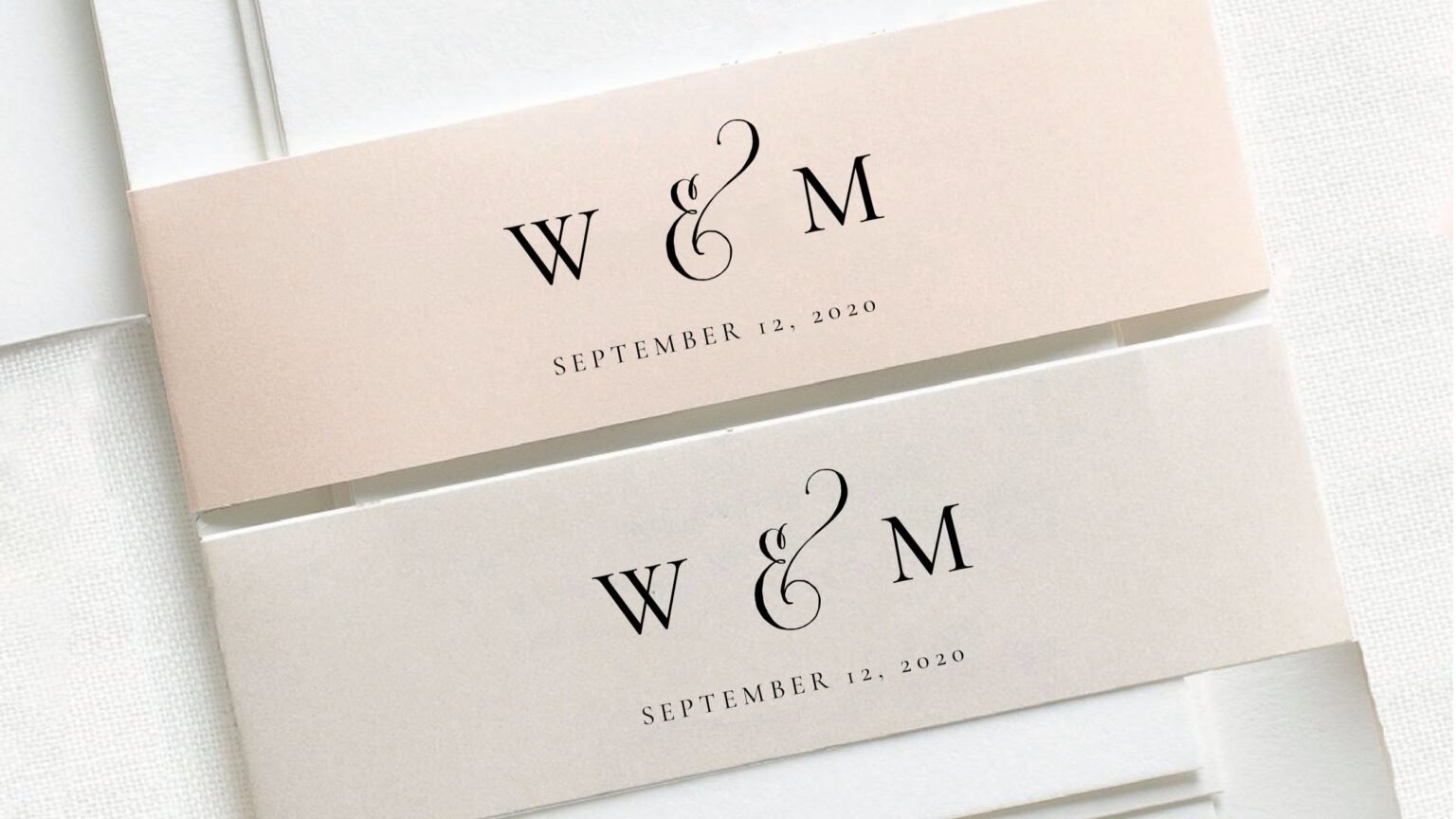
A belly band is a strip of paper, vellum, or similar material that wraps around the middle of the stack. Most paper belly bands are decorative and functional at the same time. They help hold the main invitation and enclosure cards together, and they give the finished invite a more gathered, finished appearance.
That makes a belly band especially useful when your wedding suite includes multiple loose pieces. A single card invitation may not need one. But a fuller wedding invitation suite often benefits from it. If your stack includes a reception card, details card, response envelope, RSVP card, and maybe an accommodations card or party insert, the band helps everything stay in the correct order.
It also gives you another place to add style. Some couples use a belly band with a monogram, names, or wedding date. Others use a vellum wrap for a softer look, ribbon for a more tactile finish, or wax seals as one of the final finishing touches. Those options can look beautiful, but they are not equal in assembly time or mailing ease. A paper belly band is usually the easiest way to create a polished look without adding much bulk.
What to gather before you begin assembling
Before you begin assembling, set everything out on a clean surface and sort it first. This is one of the easiest ways to save time and avoid mistakes. You do not want to discover halfway through the stack that some guests should receive a rehearsal dinner card and others should not.
Lay out the full suite before you start:
- main invitation
- reception card
- details card
- accommodations card
- RSVP cards
- response envelope
- belly band
- vellum wrap, if you are using one
- ribbon, if you are using one
- inner envelopes, if your suite includes them
- outer envelope
- envelope liners, already attached
- stamps
- double sided tape or clear stickers
- damp sponge for sealing
- fabric shears if you need to trim ribbon
If different guests are receiving different enclosure cards, manually sort those piles first. This matters for out of town guests, wedding party members, or anyone invited to extra events. It is much easier to build a correct stack from pre sorted groups than to think through each variation during assembly.
Also check that your response envelope already has the return mailing address, and that your outer envelope addressing is ready to go. A pre addressed response envelope is one of those small details that makes RSVP cards more useful and more likely to come back.
Step by step process to assemble wedding invitations with a belly band
1. Start with the main invitation
Place the main invitation at the bottom of the stack. It should sit print side up.
This is usually the largest card in the suite, and it is the anchor for everything else. It carries the couple’s names, ceremony information, and wedding date, so it should be the piece that defines the size and alignment of the whole stack.
If you are using a folded invitation, keep that in mind from the beginning. A folded invitation changes where some insert pieces go later. If you are using a single card invitation, the remaining pieces will stack neatly on top.
2. Add tissue paper or vellum, if you want it
If your suite includes tissue paper, place it over the main invitation before the other enclosure cards go on top. Tissue paper is optional. Historically it helped protect raised printing or fresh ink. In many modern wedding invitations, it is now more of a style choice than a requirement.
If you are using a vellum wrap that goes around the whole suite, do not add it yet. A full vellum wrap usually comes after the stack is complete. A single vellum sheet over the invitation card is different from a full wrap around the entire suite.
3. Stack the enclosure cards in size order
Next, add the enclosure cards on top of the main invitation, print side up. In most cases, you will stack them in size order so the largest card sits closest to the invitation and the smallest is nearer the top.
A common order looks like this:
- main invitation
- reception card
- details card
- accommodations card
- rehearsal dinner card or other event card
If two cards are the same size, use common sense. Put the more important or broadly relevant information first. That usually means the reception card or details card comes before more specialized inserts.
If you are working with a folded invitation, place the enclosure cards inside the fold instead of stacking them on top. That keeps the suite tidy and helps prevent smaller cards from shifting out of place.
4. Add the response envelope and RSVP card
Place the response envelope on top of the enclosure cards. Usually it sits print side down with the flap on the left side. Then slide the RSVP card under the flap, print side up, so the text facing the guest is visible when they lift the top piece.
This small detail makes the whole stack feel intentional. It also helps the response envelope and RSVP card stay together, which is useful if you are assembling a large number of wedding invitations at once.
If you are not mailing reply cards because guests will answer online, you can skip this step and keep the stack slimmer. But if you are using printed RSVP cards, this is the standard place for them.
5. Wrap the belly band around the whole suite
Now that the stack is complete, it is time to wrap the belly band around the entire suite.
Center the band on the front of the stack. Make sure any printed design, names, or motif are right side up and aligned before you move on. Once it looks centered, hold the stack steady, flip it face down on the clean surface, then wrap the band around the back.
Pull one end across the back first. Then pull the other end across so they overlap neatly. Secure the overlap with double sided tape or a clear sticker. The join should sit on the back of the suite, not the front.
The band should be snug, but not tight enough to bend the cards. A too tight band can bow the invitation card, make the edges curl, or create a slightly strained look. A too loose band does the opposite. It lets the stack slide around and defeats the whole point.
If you are also using a vellum wrap, wrap the vellum around the whole suite first, then place the belly band around the vellum. If you are using ribbon, tie it after the stack is assembled and measured. Ribbon can look lovely, but it adds more assembly time and more bulk. Trim the ends with fabric shears so they stay clean instead of fraying.
Wax seals are best treated carefully. If you want that detail, placing a wax seal on a belly band or vellum wrap is often easier than using one on the outside of the mailing envelope.
6. Insert the suite into the envelope the right way
Once the suite is fully assembled, slide it into the envelope.
If you are using inner envelopes, place the assembled stack into the inner envelope first, then place the inner envelope into the outer envelope. If you are not using inner envelopes, put the whole suite directly into the outer envelope.
For a single card invitation, insert the stack left edge first. For a folded invitation, insert the folded edge first. In either case, the text facing up toward the envelope flap is the usual arrangement. When your guest opens the envelope, they should see the printed side of the invitation first.
If your outer envelope includes envelope liners, make sure they are already attached and lying flat before you insert anything. Envelope liners can add a beautiful finishing touch, but a loose liner corner can catch on the stack if you rush the assembly.
What usually goes wrong
The most common mistake is not the belly band itself. It is the sorting.
People often start wrapping before they have decided which guests get which cards. Then they have to undo the whole suite because one group needs an accommodations card, another gets a rehearsal dinner insert, and another only gets the main invitation and details card. Sort first. Assemble second.
The next common problem is making the band too tight. A belly band should hold the suite together, not squeeze it. If you have to force the paper around the stack, stop and adjust.
Another issue is adding too many finishing touches to the outer envelope without thinking about mail. Ribbon, bulky wax seals, very thick stacks, or irregular outer envelope elements can complicate postage and processing. That does not mean you cannot use them. It means you should test them before doing all of them.
The smartest mailing step is the post office test
Before you stamp the entire batch, take one fully assembled invitation suite to the post office.
This matters more than people expect. A suite with multiple enclosure cards, ribbon, wax seals, or bulky paper can mail very differently from what it looks like on your table. If the outer envelope is rigid, lumpy, unusually shaped, or embellished, it may need extra postage or nonmachinable handling. And if some guests are getting extra inserts, weigh both versions.
Also, seal one real sample with the same stamp, envelope, and assembly method you plan to use for the final mailing. That gives you the most accurate answer. It is one of those mildly unromantic steps that protects you from much more annoying problems later.
Use a damp sponge to seal envelopes cleanly once you are ready. Too much moisture can wrinkle paper. Too little may not seal well. Then add postage only after you know the correct amount.
Belly band, vellum wrap, or ribbon?
If your priority is the cleanest assembly process, a paper belly band is usually the easiest choice. It keeps the whole suite together, looks polished, and does not take as long as individually tying ribbon.
A vellum wrap gives a softer, more layered look. It can feel elegant and airy, especially for floral or modern designs. But it adds another material and another step.
Ribbon can be beautiful, especially for more formal wedding invitations, but it is slower to tie and more likely to add thickness. It is usually the least efficient option if you are assembling a large suite by hand.
So if your goal is to create a polished look with the least amount of fuss, paper belly bands tend to be the most practical middle ground.
FAQs
Do I need inner envelopes if I use a belly band?
No. Inner envelopes and a belly band do different jobs. Inner envelopes add another layer of formality and structure. A belly band simply holds the suite together. Many modern wedding invitations use only an outer envelope and a belly band.
What order should the cards go in?
Start with the main invitation on the bottom, then add enclosure cards in size order, usually from largest to smallest. Put the response envelope on top, then slide the RSVP card under the flap.
Should the RSVP card go inside the response envelope?
No. The usual setup is to place the RSVP card under the flap of the response envelope so the printed side is visible.
Can I use a wax seal with a belly band?
Yes. A wax seal on the belly band or inside the suite is often easier to manage than a wax seal on the outside of the mailing envelope.
Do I need to take a sample to the post office?
Yes, especially if your suite includes several cards, ribbon, wax seals, square envelopes, or other finishing touches. One sample can save you from guessing on postage.