
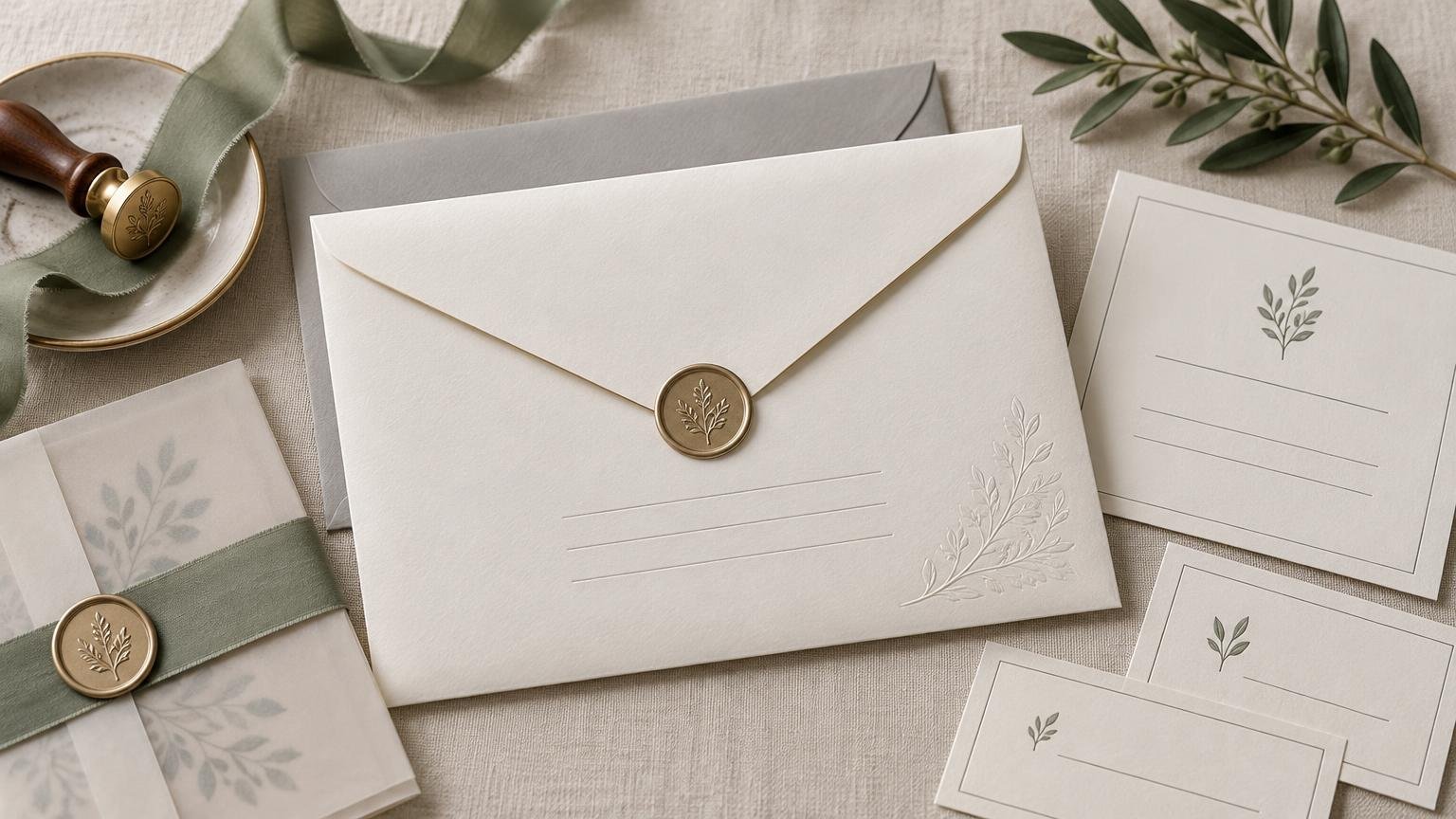
TLDR: Learning how to formally address wedding invitations starts with two priorities: identify exactly who is invited, then use each guest’s correct name and preferred title. Traditional formats are useful templates, not rules that override someone’s identity or household structure. Put complete recipient and delivery information on the outer envelope, use an inner envelope only if it helps clarify the invitation, and check every address before mailing.
The most formal envelope will still feel careless if a surname is wrong, a child is unintentionally included, or a guest receives an unwanted honorific. Build your address list household by household, confirm uncertain names and titles, and choose one consistent style. The examples below provide a starting point for common situations.
How to formally address wedding invitations
A formal outer envelope generally uses full names, appropriate courtesy titles, and a complete mailing address. Traditional social wording may spell out titles such as Doctor, but a consistent modern style using Mr., Ms., Mrs., Mx., and Dr. can also look polished. Emily Post’s wedding-invitation guidance provides formal examples for varied titles and household arrangements. Review the Emily Post addressing guide when you need a traditional reference for an unusual situation.
Before applying any template, confirm how the recipient actually uses their name. Do not assume that married partners share a surname or that a woman uses Mrs. Ask when you are unsure about a professional title, a gender-neutral title, name order, spelling, or a couple’s preferred collective form.
For a consistent formal style:
- Use each adult guest’s full preferred name.
- Use titles consistently across the guest list, unless an individual prefers no title.
- If including a middle name, spell it out rather than switching between full names and initials.
- Include suffixes such as Jr. or III when they are part of the guest’s name.
- Name an invited partner whenever you know that person’s name.
- Check the exact apartment, suite, or unit designation and ZIP Code against a reliable record.
Formal addressing examples for couples
Couples can be addressed in several correct ways. The best choice depends on their names, titles, preferences, and the level of tradition you want. For more variations focused specifically on spouses, see how to address wedding invitations to a married couple.
Married couple with a shared surname
A traditional form is:
Mr. and Mrs. Thomas Warren
That format remains recognizable, but it identifies one spouse through the other spouse’s name. It is appropriate only when you know the couple uses and likes that convention. A formal alternative that names both people is:
Mr. Thomas Warren and Ms. Elena Warren
You may place both names on one line if space allows or use two lines while keeping the word “and” before the second name. Choose an order that reflects the couple’s preference; if no preference is known, alphabetical order is a neutral option.
Married couple with different surnames
Write both complete names:
Ms. Elena Garcia and Mr. Thomas Warren
Do not combine their surnames, add a shared surname, or assign Mrs. automatically. If the names do not fit comfortably on one line, place each person on a separate line. Keep “and” to communicate that they are being invited as a couple.
Same-gender married couple
The simplest formal approach is to give each person an individual title and full name:
Mr. Adrian Flores and Mr. Daniel Kim
or:
Ms. Camille Brooks and Ms. Renee Foster
Traditional plural forms exist, but preferences vary. Emily Post specifically recommends asking male couples which plural form they prefer rather than making an assumption. Individual titles are often clearer when you cannot confirm a collective preference.
Unmarried partners living together
List both invited partners by name, either on the same line or on separate lines:
Ms. Jordan Patel and Mx. Avery Chen
Mx. is a gender-nonidentifying title recognized in contemporary correspondence guidance. As with any title, use it because you know it is the guest’s preference, not because you are guessing.
If partners do not live together, send the invitation to the person in the household where it can reliably be delivered. Name the other partner on an inner envelope or invitation enclosure if you use one, or consider sending separate invitations when that will avoid confusion.
Families, children, and adult household members
An envelope should make the invitation’s scope clear. Addressing an envelope only to “The Rivera Family” may imply that everyone in the household is invited. That can work when the entire household is included, but listing names is more precise.
A formal outer envelope for parents might read:
Mr. Gabriel Rivera and Ms. Sofia Rivera
If young children are invited and you use an inner envelope, it can list everyone included:
Gabriel, Sofia, Lucia, and Mateo
Without an inner envelope, list the invited children beneath the adults when space and your chosen style allow. Adult children should normally receive their own invitation, even if they live with their parents, because they are separate adult invitees. Household composition can become complicated, so use the guest list—not assumptions about a surname—to decide who appears. See the detailed guide to addressing families, plus-ones, and children for additional examples.
How to handle plus-ones
If you know the invited companion’s name, use it. “Ms. Priya Shah and Mr. Noah Bennett” is more personal and precise than “Ms. Priya Shah and Guest.” Confirm the companion’s full name and spelling before addressing the envelope.
When the guest may choose any companion and you do not know that person’s identity, “and Guest” is acceptable. On a traditional two-envelope suite, the outer envelope can be addressed to the named guest and the inner envelope can say “Ms. Shah and Guest.” With one envelope, include both on the outer envelope or make the plus-one allowance unmistakable through the RSVP process.
Do not use “and Guest” merely because you have not taken time to learn the name of a known spouse or partner. It can make an established partner appear interchangeable and may create uncertainty about who is actually invited.
Doctors, military members, judges, and official titles
Professional and official titles require more care because the correct form can depend on the office, service, rank, retirement status, and the other person in the couple. For a physician who uses the title professionally, a straightforward example is:
Doctor Maya Shah and Mr. Elias Shah
If both guests are doctors, use both preferred names rather than assuming a collective form:
Doctor Maya Shah and Doctor Elias Shah
For military ranks, judges, elected officials, clergy, and other dignitaries, confirm the current title and the person’s preferred social form. Do not guess based on an old directory, social profile, or someone else’s recollection. Consistency matters, but accuracy matters more.
Inner and outer envelopes serve different purposes
The outer envelope is the mailing envelope. It needs the recipient’s delivery address, postage, and a return address. The optional inner envelope does not travel through the mail; traditionally, it identifies the people included in the invitation and may use a slightly less formal version of their names.
Formal invitations do not require inner envelopes. A single-envelope suite can still be fully formal when the recipients are clearly named. An inner envelope is most useful when you need to distinguish invited household members, name a plus-one, or protect the presentation of the suite. Read the practical comparison of inner and outer envelopes before adding another envelope solely for tradition.
If you use an inner envelope, it is generally left unsealed. Assembly details are covered in whether to seal a wedding invitation’s inner envelope.
Separate social style from postal requirements
Formal etiquette determines how you present guests’ names. Postal formatting determines whether the envelope can be processed and delivered. The two goals can coexist, but delivery clarity should never be sacrificed for appearance.
USPS guidance calls for a clear delivery address, appropriate secondary-unit information such as an apartment or suite, a correct ZIP Code, a return address, and postage in the upper-right corner. Check the current USPS addressing guidance before mailing.
Center the delivery block in the usable address area and keep it legible against the envelope color. Decorative calligraphy should not obscure letters or numbers. If you use a dark envelope, make sure the addressing method produces strong contrast and remains readable; the guide to choosing black envelopes for wedding invitations explains the practical tradeoffs.
Traditional stationery styles sometimes spell out street types, state names, and numbers. Postal standards may favor standardized address elements. Rather than rewriting a verified address to make it look more formal, preserve complete, accurate delivery information. Also verify postage using a fully assembled sample because weight, thickness, shape, rigidity, and embellishments can affect mailing requirements.
Pre-mail addressing checklist
- Confirm the spelling and current surname of every invited person.
- Confirm titles instead of inferring them from gender, profession, or marital status.
- Make sure every invited adult is named somewhere in the suite or RSVP process.
- Clarify whether children and plus-ones are included.
- Give adult household members separate invitations when appropriate.
- Check street numbers, unit designators, city names, and ZIP Codes.
- Add a usable return address; review return-address etiquette for wedding invitations if you are deciding whose address to use.
- Review one complete household example before applying the format to the full list.
- Proofread envelopes separately from the invitation cards.
- Assemble and weigh a finished sample before purchasing postage or mailing the full batch.
Proof the guest list before envelope addressing begins. PrintInvitations states that every order includes a free digital proof and that production begins after proofing is complete, but the names and addresses used for mailing still need their own careful review. If you are also finalizing the cards, coordinate the envelope style with your wedding invitation wording so the full suite uses a consistent level of formality.
The best formal format is accurate, clear, and respectful
Formal addressing does not require treating every household as though it follows one traditional pattern. Start with full preferred names, use confirmed titles, name every invited adult, and make children or plus-ones explicit. Then check that the physical envelope is legible and contains complete mailing information.
Before ordering or addressing the full set, test your chosen format on several different households: a couple with a shared surname, a couple with different surnames, a family with children, a single guest with a plus-one, and a guest with a professional title. If those cases are clear and consistent, the rest of the list will be much easier to complete without awkward corrections or remailing.