
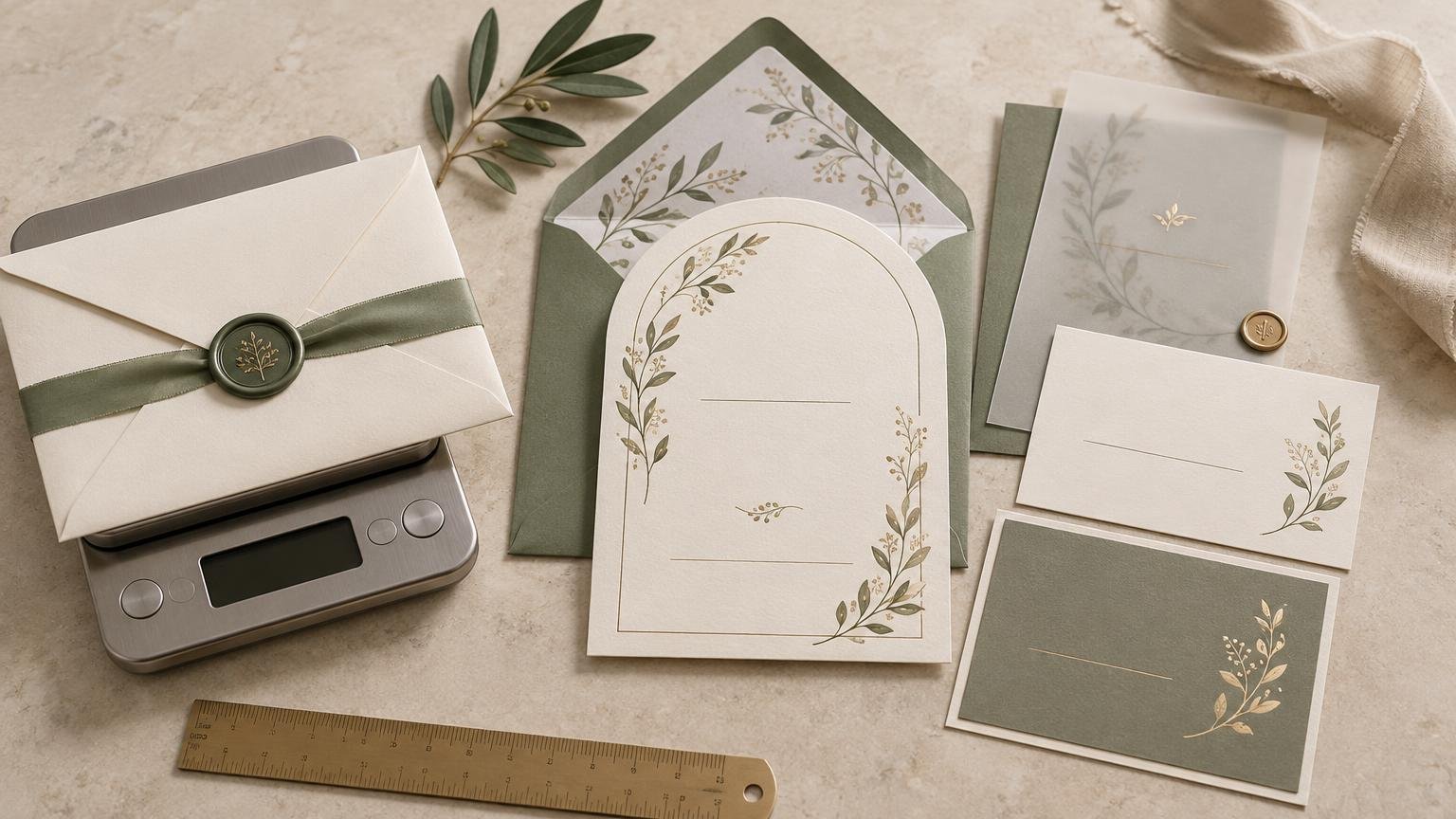
TLDR
The cost to mail a wedding invitation is determined by the fully assembled outer mailpiece. Weight matters, but so do dimensions, thickness, flexibility, shape, address orientation and exposed embellishments. A square envelope, rigid suite, wax seal or uneven bundle can require a nonmachinable surcharge or move the piece into another mail category. Assemble one complete invitation exactly as a guest will receive it, then take that sealed and addressed sample to a Post Office counter before buying stamps.
What makes wedding invitation postage increase?
A standard-looking invitation can become more expensive once the RSVP card, reply envelope, details card, liner and decorative pieces are added. USPS evaluates the complete envelope rather than the main invitation by itself. The practical question is not “How much does a 5-by-7 invitation cost to mail?” but “How will USPS classify this finished suite?”
| Cost factor | Why it matters | What to check |
|---|---|---|
| Weight | Postage rises when the piece enters the next ounce tier. | Weigh the sealed suite, including every insert. |
| Dimensions | A piece must remain within letter limits to receive letter pricing. | Measure the outer envelope, not the invitation card. |
| Shape | Square and unusually proportioned letters are nonmachinable. | Calculate the envelope’s length-to-height ratio. |
| Thickness and rigidity | Thick, stiff or uneven pieces may not run through letter-processing equipment. | Check the finished bundle, closures and embellishments. |
| Exterior details | Wax seals, ribbon, clasps and similar features may affect processing. | Protect decorations with a suitable outer envelope. |
| Address orientation | The delivery address should run parallel to the long dimension. | Confirm orientation before printing or writing addresses. |
Weight is only the starting point
USPS charges First-Class Mail postage by each ounce or fraction of an ounce. That means a suite weighing 1.01 ounces falls into the over-1-through-2-ounce tier rather than the 1-ounce tier. Small additions can therefore matter: an envelope liner, reply envelope or heavier details card may push an otherwise simple suite across a pricing boundary.
The USPS Notice 123 schedule effective October 4, 2026 lists domestic single-piece letter prices of $0.82 through 1 ounce, $1.11 over 1 through 2 ounces, $1.40 over 2 through 3 ounces and $1.69 over 3 through 3.5 ounces. It lists a $0.49 nonmachinable surcharge. These are dated rates, not permanent figures, so use the current USPS Notice 123 price list when you are ready to mail.
When estimating the full stationery budget, include postage alongside printing, envelopes and assembly supplies. This is especially important when comparing DIY and professional invitation printing costs, because a design that is inexpensive to print may still cost more to mail.
Letter dimensions and shape affect classification
For USPS domestic letter classification, a piece must be at least 5 inches long, 3.5 inches high and 0.007 inch thick. It can be no more than 11.5 inches long, 6.125 inches high and 0.25 inch thick, with a maximum letter weight of 3.5 ounces.
A common 5-by-7-inch invitation card is not automatically nonmachinable. Classification depends on the assembled outer envelope, including its orientation, dimensions, weight, thickness, flexibility and closures. That distinction matters when planning a coordinated wedding invitation suite with several inserts.
Shape is another frequent surprise. A letter’s aspect ratio is its length divided by its height. USPS treats ratios below 1.3 or above 2.5 as nonmachinable. A square envelope has a ratio of 1, so it is nonmachinable when sent as a letter. The address should also run parallel to the envelope’s long dimension.
Rigidity, thickness and uneven contents can add cost
Automated letter equipment expects a mailpiece to be flexible enough and even enough to process. Excessive rigidity, loose bulky contents, clasps, strings, buttons and similar closures are among the characteristics that can make a letter nonmachinable. Larger letters can also be nonmachinable when they are unusually thin. The official USPS retail mail standards provide the governing measurements and characteristics.
This is why thick stock deserves attention. A substantial card is not necessarily a postal problem by itself, but the complete stack may become stiff or uneven after inserts are added. If you are considering double-thick wedding invitations, obtain or assemble an accurate sample before assuming ordinary letter postage will apply.
Exceeding letter limits does not automatically make a suite a flat. A First-Class Mail flat must meet its own standards, including being rectangular, flexible and uniformly thick. A rigid, nonrectangular or uneven piece that fails those standards may be charged as a parcel instead.
Wax seals and embellishments require special care
Wax seals, ribbon, string and raised decorations can create an uneven or rigid spot. USPS advises placing an invitation with exposed external decorations inside another envelope rather than mailing those features unprotected. Its consumer guidance also recommends taking decorated invitations to a Post Office counter, paying the nonmachinable rate when applicable and requesting hand-canceling. USPS invitation-mailing guidance explains these precautions.
Hand-canceling is not a substitute for correct postage or classification. It addresses how the postage is canceled, but the envelope still needs to meet applicable standards and may encounter processing equipment later. Loose hard objects can tear an ordinary paper envelope, jam equipment, delay delivery or become lost.
Why you should check a finished sample
Do not weigh an empty envelope or an incomplete stack. Prepare one sample with the exact invitation, every insert, the reply envelope, liner, belly band or other wrap, and any embellishment. Seal it and add the address in its intended orientation. This reveals the mailpiece’s real weight, dimensions, thickness, flexibility and balance.
- Assemble the complete suite using the final paper and envelopes.
- Seal and address it exactly as the mailed invitations will be prepared.
- Weigh it on an accurate postal scale, but do not rely on weight alone.
- Measure the outer envelope and check its thickness, shape and flexibility.
- Take the sample to a Post Office counter and ask how it will be classified.
- Confirm the required postage before purchasing stamps for the full quantity.
USPS also provides a Postage Price Calculator, but a counter check is particularly useful for a suite with unusual thickness, rigidity or decoration.
The safest postage plan
Choose the complete invitation format before committing to postage. A rectangular, flexible and evenly packed suite is usually easier to mail than a square, rigid or heavily embellished design, but only the finished mailpiece provides a reliable basis for classification. Check one exact sample, confirm the current USPS price, and then buy stamps. The standards and prices discussed here apply to domestic U.S. First-Class Mail; international invitations require destination-specific postage research.