
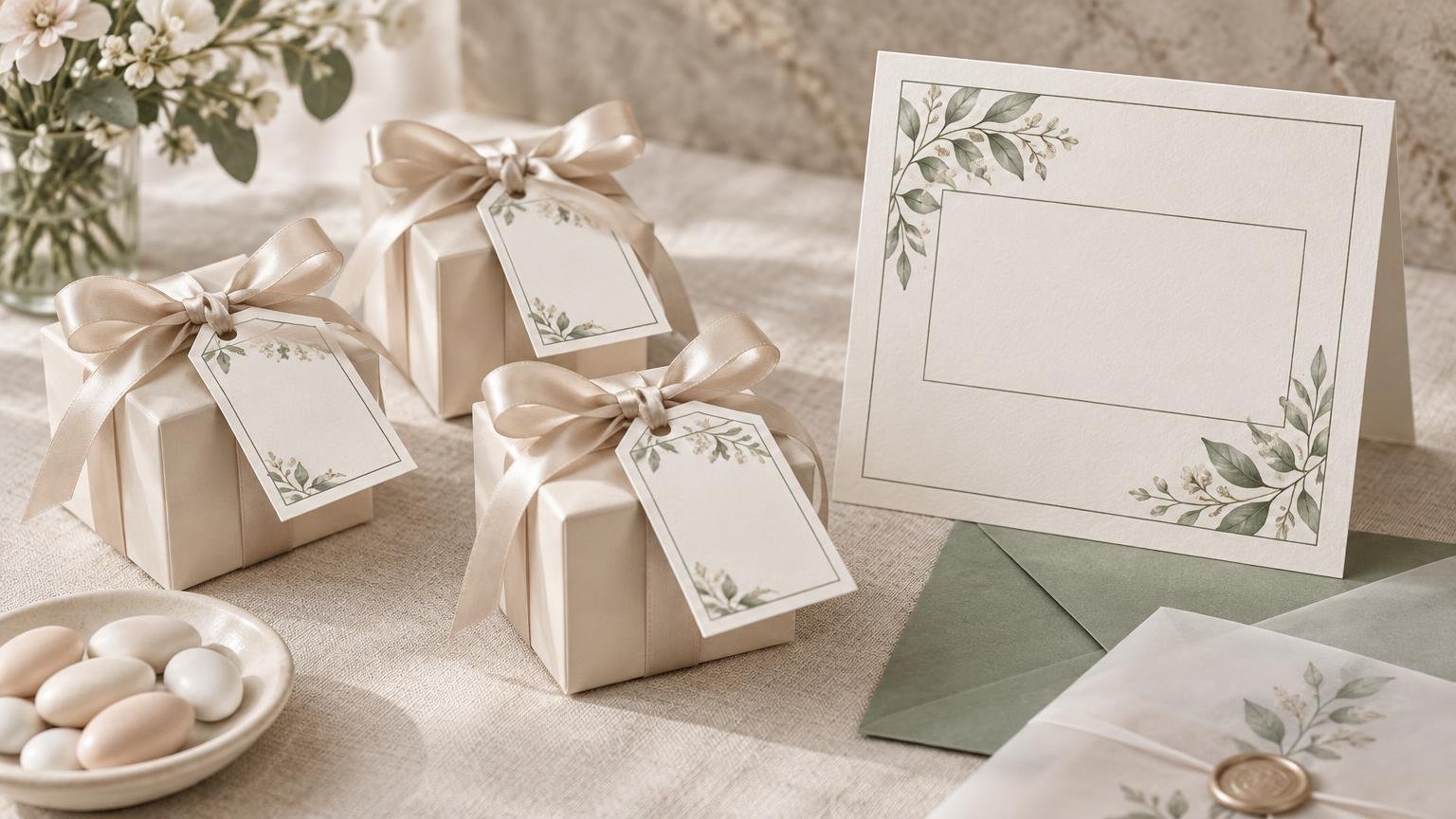
TLDR: Wedding favors are optional. If you want to provide them, choose something compact, consumable, useful during the event, or genuinely relevant afterward. The best wedding favors guests will actually keep are easy to carry, easy to understand, and not so heavily personalized that they only make sense to the couple. A concise tag, label, place card, or pickup sign can make a simple item feel connected to the rest of the wedding.
There is no favor with a guaranteed keep rate. Guest preferences, travel plans, dietary needs, and the setting all matter. Instead of asking which object looks most impressive in a photograph, ask whether guests have a clear reason to eat, use, share, or carry it. If the answer is uncertain, spending that budget on guest comfort or thoughtful wedding thank-you cards may be more worthwhile.
How to Choose Wedding Favors Guests Will Actually Keep
A practical favor usually passes four tests: it serves a recognizable purpose, does not create a transportation problem, suits a broad portion of the guest list, and needs little explanation. Couple-specific branding should support the presentation rather than overwhelm the item.
- Useful or consumable: Guests can eat it, drink it, use it at the event, or use it at home.
- Compact: It fits easily in a pocket, handbag, suitcase, or vehicle without special packing.
- Guest-centered: The favor reflects what recipients might enjoy, not only the wedding theme.
- Simple to distribute: Guests immediately understand whether to take one per person, couple, or household.
- Lightly personalized: Names, initials, or the wedding date appear on removable packaging rather than dominating a reusable object.
- Appropriate for the setting: The item can tolerate the venue temperature, transportation, and time spent on display.
Run the idea through a realistic scenario. A local guest driving home may happily take a small jar, candle, or bottle. A guest flying with limited luggage may prefer a flat keepsake, packaged snack, or something consumed during the weekend. An outdoor summer reception may be unsuitable for favors that melt, wilt, leak, or require refrigeration.
Favor Categories and Their Practical Tradeoffs
| Favor type | Why it may work | What to verify |
|---|---|---|
| Edible or drinkable | It has an immediate purpose and does not require permanent storage. | Ingredients, allergens, shelf life, venue rules, temperature, and transport limits. |
| Useful during the event | It can solve an immediate comfort or convenience problem. | Weather, venue conditions, sizing, distribution, and whether the item is genuinely needed. |
| Compact household item | Guests may use it after the wedding if the design is broadly appealing. | Quality, weight, breakability, and how prominently it is personalized. |
| Local or story-based item | It can connect guests to the location or the couple’s background. | Availability, packaging, travel restrictions, and whether a short explanation is needed. |
| Place card plus favor | It combines a necessary seating function with a takeaway. | Name accuracy, alphabetization, table assignment changes, and setup labor. |
| Experience or redeemable item | It avoids adding another physical object to a guest’s luggage. | Redemption instructions, expiration, accessibility, and whether all guests can use it. |
Edible favors
Wrapped cookies, chocolates, tea, coffee, spice blends, or other small foods can be approachable because their purpose is obvious. They can also create complications: allergies, dietary restrictions, heat sensitivity, local food rules, and short shelf life. Use ingredient or allergen information when appropriate, and confirm what the venue permits before ordering.
Simple does not have to look unfinished. A neatly sealed package with one restrained label can feel more intentional than an elaborate box with several layers of ribbon and filler. The packaging should protect the food first; decoration comes second.
Items guests can use at the wedding
A favor can earn its place by improving the event itself. Depending on the venue and season, that might mean a practical comfort item, a reusable cup permitted by the caterer, or another small item guests can use immediately. Avoid buying a weather-related product too early unless the need is predictable. A basket of optional items may also be more efficient than placing one at every seat.
Compact items for after the wedding
If the favor is meant to last, keep the design versatile. A useful object printed permanently with large names and a wedding date may feel less useful in someone else’s home. Put the wedding-specific artwork on a removable band, sticker, tag, or box so the underlying item remains broadly usable.
Plan Quantities Around How the Favor Will Be Used
One favor per guest is not an etiquette requirement. The right unit depends on the item. An individual snack or assigned place-card favor generally calls for one per attendee. A shareable food item, household product, or locally made gift may make more sense per couple or household.
Start with the latest attendance estimate, then separate children, couples, households, vendors, and guests with dietary or accessibility considerations as relevant. Add a modest buffer for damaged packaging, late additions, display samples, and keepsakes. Do not apply an automatic percentage if the supplier sells in fixed case quantities; compare the case size with the number you actually need.
For a large guest list, favor complexity matters as much as unit price. Tying 180 tiny ribbons, handwriting 180 tags, or matching 180 favors to place cards can consume hours. Before ordering, assemble one complete sample and time the process. Multiply that time by the quantity, then decide whether the design still makes sense.
Use Stationery to Make a Simple Favor Feel Intentional
The favor does not need to repeat every visual element from the invitation. One shared typeface, color, border, illustration, or monogram is usually enough to establish continuity. PrintInvitations currently centers its collection on wedding invitations, save the dates, RSVP cards, details cards, thank-you cards, and matching stationery, and supports both personalized templates and finished artwork uploads. It also states that orders include a digital proof before printing. Confirm current product availability before assuming a particular favor tag, place card, or day-of piece can be ordered.
If you are still defining the overall paper system, a coordinated wedding invitation suite can establish the typography and colors that later appear on favor packaging. Keep the main invitation focused on who, what, when, and where. Travel guidance and other essential logistics can go on a wedding details card, but favor pickup instructions belong at the reception rather than in the mailed suite.
When stickers and labels are useful
Labels work well when they perform a job: sealing a treat bag, identifying a flavor, listing a short ingredient note, marking welcome-bag contents, or connecting plain packaging to the wedding design. Couples who need this format can explore custom stickers for wedding favor packaging. Measure the actual container or bag before ordering, and test one printed sample on the intended surface. Curved, textured, chilled, or condensation-prone containers can behave differently from a clean, flat package.
CustomStickers.com states that customers can upload a wedding-sticker design and order quantities ranging from one to thousands. Treat the final quantity, material, finish, production schedule, and application suitability as details to verify on the current product page before ordering.
Favor Tag and Pickup Sign Wording
Favor wording should be short enough to read at a glance. A tag can thank the guest, identify the item, or provide one useful instruction. It does not need to retell the couple’s relationship history.
Short favor-tag examples
- Thank you for celebrating with us.
- A little treat for the trip home.
- Made locally with love. Please enjoy one per household.
- Find your seat and take this home as our thanks.
- A small taste of our favorite place.
- Thank you for being part of our day.
- Please enjoy tonight or take one for later.
Pickup-sign examples
- Please take one favor per guest.
- Please take one per couple or household.
- Choose your favorite flavor and enjoy.
- Find your name, then take your place card favor to your table.
- Don’t forget a treat for the trip home.
If the item has ingredients, use instructions, a local story, or a redemption step, put that information on a separate card or the back of the tag. Prioritize readable type over decorative script. A beautiful explanation is not useful if guests cannot read it in dim reception lighting.
Choose the Distribution Point Before the Packaging
Place-setting favors work when each guest should receive an individual item and staff can set them out accurately. They also make the tables look fuller, which may or may not suit the design. Confirm that the favor will not crowd plates, glassware, menus, or centerpieces.
An exit or pickup table works well for optional, shareable, or bulky favors, but it can be missed. Put it along the natural departure route, provide a clear sign, and assign someone to check the display later in the evening. If guests are expected to take one per household, say so directly.
Place-card favors can reduce the number of separate objects at each setting, but they require strict organization. Proof every name carefully, sort the pieces in the venue’s preferred order, and plan for late seating changes. Keep a few unprinted or neutral replacements available if the format allows.
Do Not Put Bulky Favors in the Invitation Envelope
A favor should generally be distributed at the wedding, welcome event, or hotel rather than inserted into the mailed invitation. USPS guidance for letters emphasizes flat, flexible contents. Rigid, uneven, or otherwise nonmachinable mail can require different handling and affect postage. Review the current USPS letter-mail guidance before mailing an unusual enclosure.
Even a small object can change an envelope’s thickness, flexibility, weight distribution, or ability to pass through processing equipment. Assemble a complete sample exactly as guests will receive it, then have it assessed before buying postage. The same caution applies to thick knots, raised embellishments, keys, charms, and other hard inserts. For more preparation detail, see the guide to wedding invitation postage and assembled-suite checks.
A Simple Decision Path
- For many flying guests: choose something compact, flat, consumable, or usable during the wedding weekend.
- For a large guest list: favor simple packaging and shareable or easy-to-stage items.
- For a tighter budget: use one good edible item with a clear label instead of elaborate multi-part packaging.
- For a destination wedding: consider a locally meaningful item, but check luggage, agricultural, alcohol, and transportation constraints as applicable.
- For assigned seating: consider a place card that also carries or identifies the favor.
- For guests with varied needs: offer a choice or make the favor optional rather than placing the same item at every seat.
- If no idea passes the usefulness test: skip favors and direct the budget toward guest comfort or a thoughtful thank-you afterward.
The Best Favor Is Easy to Accept—or Decline
Wedding favors work best when they feel like a thoughtful extra, not an obligation for either the couple or the guest. Choose an item with a clear use, test its packaging, decide who should receive one, and make pickup instructions obvious. Then carry one or two visual details from the invitation into the tag, label, or sign.
Before placing the full order, build one finished favor and carry it around for a day. Check whether it leaks, melts, sheds, tears, or becomes awkward in a small bag. If it survives that test and still feels useful, you have a much stronger candidate for a favor guests may be happy to take home.