
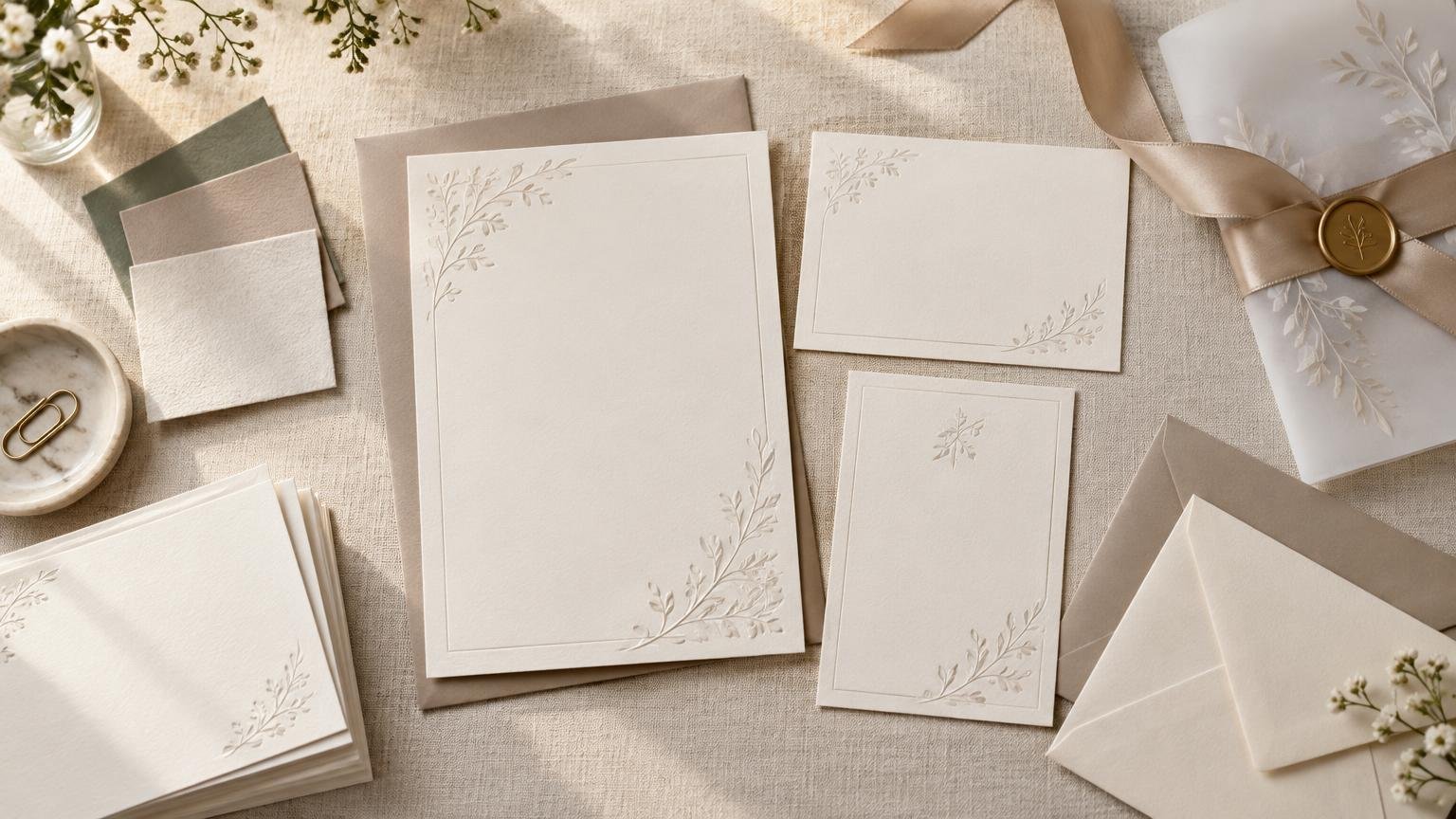
TLDR: The Knot reports an average spend of $220 on wedding invitations including RSVP cards, based on its 2026 Real Weddings Study of U.S. couples married in 2025. That is a planning benchmark, not a quote for every order. Your actual total depends on how many households receive invitations, which pieces are in the suite, paper and finish choices, envelopes, shipping, and postage.
If you are asking how much do wedding invitations cost, begin with the complete mailed suite rather than the advertised price of the main card. A realistic budget includes printing, inserts, envelopes, addressing or assembly supplies, delivery from the printer, outbound postage, return postage when using mailed RSVP cards, and a small quantity of extras.
How much do wedding invitations cost on average?
The available survey benchmark is $220 for invitations including RSVP cards. The same study reports an average of $510 for broader wedding stationery spending, which can encompass more than the invitations sent to guests. Do not treat those two figures as interchangeable: save the dates, ceremony programs, place cards, menus, signs, and thank-you cards can push a broader stationery budget well beyond the invitation order itself.
An average also hides substantial differences in quantity and format. One couple may mail 45 simple invitations with online RSVPs. Another may send 140 suites containing an invitation, details card, RSVP card, reply envelope, envelope liner, and specialty finish. Their costs should not be expected to match.
The most useful comparison is the total delivered and mailed cost for the same quantity and configuration. When reviewing quotes, confirm whether the stated amount includes envelopes, printed return addresses, guest addressing, proofs, inserts, shipping, and any upgraded paper or finish.
Start with households, not the guest count
Wedding invitations are usually ordered according to mailing units. A couple, family, or household may receive one invitation even though several people from that address appear on the guest list. Begin by grouping guests according to the envelopes you will actually address.
- Create one guest-list row for each invitation mailing address.
- Count households, couples receiving a joint invitation, and individual guests receiving separate invitations.
- Add invitations for late additions, addressing mistakes, damaged pieces, keepsakes, and photography.
- Keep the surplus measured rather than automatically ordering according to the total number of guests.
For example, a 150-person guest list might produce far fewer than 150 mailing households. If the final list contains 82 mailing addresses, price the order around that number plus a deliberate buffer. The appropriate buffer depends on how settled the list is and whether ordering a small second batch would be expensive or slow.
Choose the suite before comparing prices
A low invitation-card price tells you little if you ultimately need multiple inserts. Decide what information must be printed and what can live on your wedding website before requesting comparable quotes. The wedding invitation suite printing guide explains how the individual pieces work together.
| Configuration | Typical printed contents | Budget implications |
|---|---|---|
| Invitation only | Main invitation, with event details or a website address | Lowest component count; online RSVPs can eliminate a reply card and return envelope. |
| Simple suite | Invitation plus RSVP card, often with a reply envelope | Adds printing and may add return postage; confirm exactly which envelopes are included. |
| Expanded suite | Invitation, RSVP card, details card, and related envelopes | More printing, weight, assembly, and potential postage exposure; useful when guests need substantial travel or schedule information. |
A wedding details card can keep accommodations, transportation, attire, or weekend information off the main invitation. It is useful when guests genuinely need that information in print, but it should not become a collection of details already presented clearly online. Similarly, printed wedding RSVP cards provide a traditional mail-in response method, while online responses reduce components and eliminate return postage.
The main factors that change the price
Quantity and number of components
More households mean more printed sets, envelopes, and postage. Adding an insert affects every suite, so even a modest per-piece upgrade becomes meaningful across a large order. Compare the complete quantity you need rather than a promotional starting quantity that does not match your list.
Paper and print finishes
Paper affects feel, color reproduction, and perceived formality. PrintInvitations describes smooth, felt, eggshell, pearlescent, heavier, and specialty choices, with availability varying by product. It also describes matte, gloss, satin, and foil options. Confirm the current choices and upgrade costs for the exact design under consideration rather than assuming every combination is available.
If the budget allows only one tactile upgrade, prioritize the main invitation rather than automatically upgrading every insert. A substantial or textured main card paired with simpler supporting cards can preserve the intended presentation without multiplying the premium across the entire suite. Review the practical differences in the guide to choosing invitation paper.
Envelopes, addressing, and assembly
Determine whether outer envelopes are included and whether the order includes blank envelopes, return-address printing, guest-address printing, or liners. If addressing is separate, include ink, labels, calligraphy, or a professional addressing service in the budget. Ribbons, belly bands, wax seals, and liners also add material and assembly time; some can change the finished mailpiece enough to affect postal handling.
Proofs, corrections, and reorders
PrintInvitations states that every order includes a free digital proof and that production starts after approval. It also says physical proofs or samples may be available for a fee. A digital proof is a cost-control step only if it is reviewed carefully. Names, dates, venue details, website addresses, RSVP deadlines, spelling, punctuation, and card-to-envelope quantities all deserve a separate check.
The company’s published policy says approved custom orders generally are not returnable or refundable for customer-supplied wording and errors present in an approved proof, while confirmed production or fulfillment errors qualify for replacement. This makes careful approval more than an etiquette concern: it protects the printing budget. Use the full wedding invitation proofreading checklist before approving production.
Production, shipping, and rush decisions
Shipping from the printer is distinct from postage to guests. PrintInvitations states that most orders are produced within three business days or less and most ship within one business day, but approval timing, customization, order size, demand, and transit method can affect the schedule. It lists several expedited and standard shipping methods. Verify the current estimate for your specific order and build in time for proof review, transit, addressing, assembly, and a correction if needed.
Budget for wedding invitation postage separately
Postage should be based on a finished, assembled, sealed invitation—not on the main card by itself. Inserts, a reply envelope, liners, embellishments, thickness, rigidity, shape, and dimensions can all change how a mailpiece is priced or processed.
USPS Notice 123 currently lists stamped First-Class Mail letter prices of $0.82 for one ounce, $1.11 for two ounces, and $1.40 for three ounces, plus a $0.49 nonmachinable surcharge when applicable. Consult the official USPS price list before purchasing stamps because rates can change.
USPS states that letter-size mail can be no more than 11.5 inches long, 6.125 inches high, 0.25 inch thick, and 3.5 ounces. Meeting those maximums does not by itself guarantee the lowest letter price; the piece must also satisfy applicable shape, flexibility, thickness, and other standards. Square envelopes and rigid or unusually embellished suites warrant particular attention rather than an assumption that one standard stamp is enough.
Take a fully assembled sample to the post office or otherwise have the finished specification checked before buying postage for the whole order. The wedding invitation postage guide covers the variables to review.
Use this complete invitation budget formula
Build the estimate with this formula: printed suites + envelope and addressing costs + upgrades and assembly materials + printer shipping + outbound postage + return postage + contingency for corrections or replacement mailings.
For a 100-household example, do not simply multiply a displayed invitation-card price by 100. Request a quote for the selected suite at the needed order quantity, then add the cost of mailing 100 finished outer envelopes. If you include prepaid mail-back RSVP envelopes, add the applicable return postage for each reply envelope you stamp. Finally, include printer delivery and any addressing or assembly costs. This produces a meaningful project total without pretending that one vendor’s configuration applies universally.
How to lower the cost without abandoning print
- Send one suite per mailing household instead of one per guest.
- Use an online RSVP if mailed response cards are not important to you.
- Move accommodations, maps, and lengthy schedules to a wedding website when guests can access them easily.
- Choose a conventional, mail-friendly envelope format and verify the assembled weight before committing to the design.
- Reserve specialty paper or foil for the main invitation instead of applying every upgrade to every insert.
- Proof slowly and ask another careful reader to check all variable information.
- Order a calculated surplus with the first run, particularly if a small reorder carries extra setup or shipping costs.
- Compare quotes using the same quantity, paper, suite pieces, envelope services, finish, proof type, and shipping speed.
Savings should come from removing pieces that do not improve communication, not from making the invitation difficult to read. Clear typography, sufficient contrast, accurate information, and a format that survives mailing are more valuable than decorative extras that strain the budget.
Questions to ask before placing an order
- What exactly is included in the displayed price?
- Are envelopes included, and are they blank or printed?
- Which paper and finishes are available for this specific design?
- Does the quote include every insert and the required quantity of each?
- Is a digital proof included, and what happens after approval?
- What production and shipping estimates apply to this configuration?
- What is the delivered total after upgrades and shipping?
- What will the complete sealed suite weigh and measure?
- Would a small reorder have a different unit cost, setup charge, or timeline?
The practical answer
The best answer to how much do wedding invitations cost is not a single per-card figure. The $220 survey average for invitations and RSVP cards is a useful reference point, but your working number should come from the quantity of mailing households and the complete configuration you intend to print and mail.
Count addresses first, choose the necessary suite pieces, obtain a like-for-like delivered quote, and then test the assembled mailpiece before buying stamps. That sequence exposes the real cost early and reduces the chance that inserts, postage, rushed shipping, or a preventable reprint will surprise the budget.