
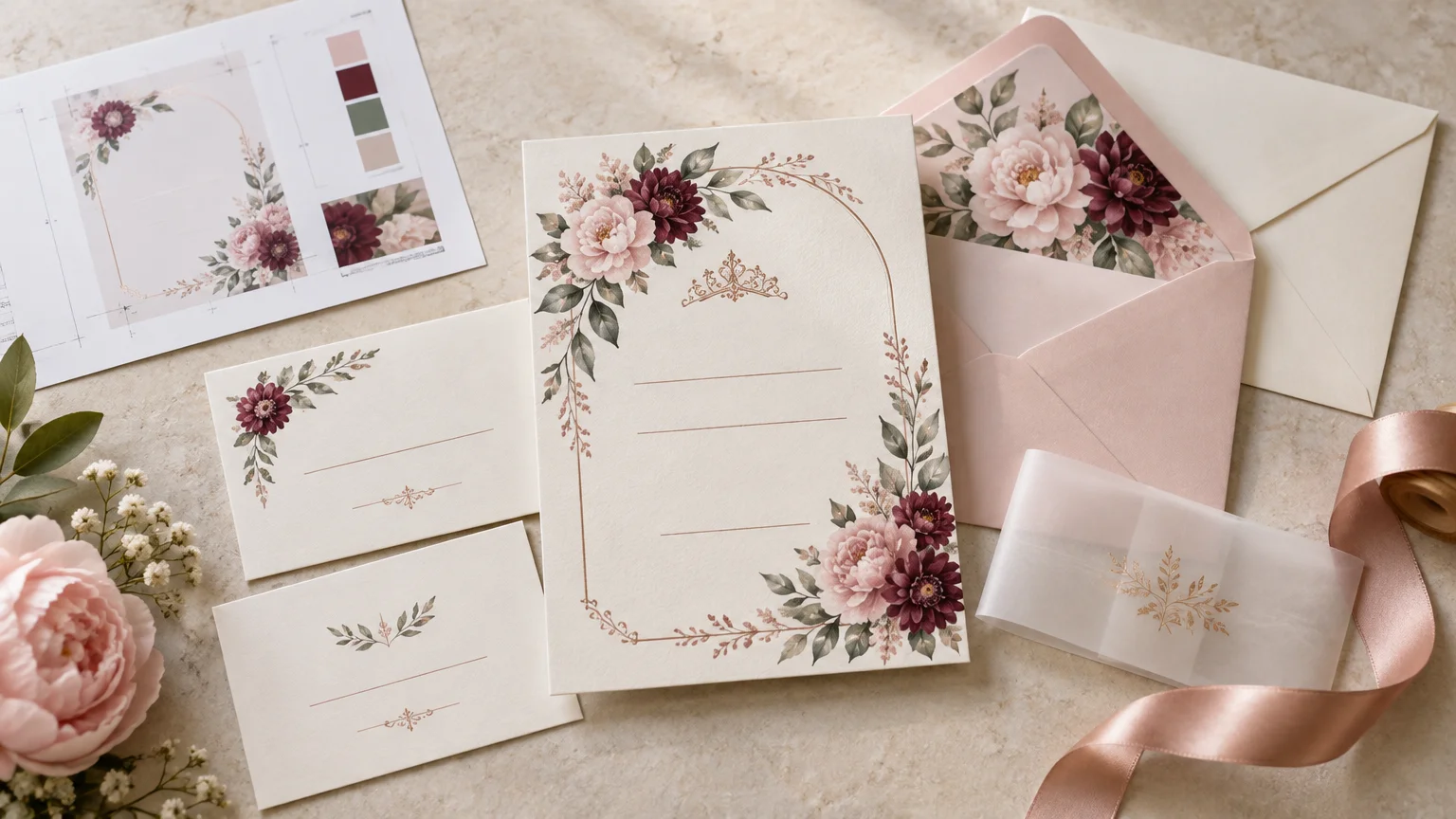
TLDR: The best place to print quinceanera invitations is a specialist printer that accepts your finished artwork, provides a proof before production, offers paper and finishes compatible with the design, and can meet the complete schedule—not merely the production date. PrintInvitations is a strong conditional choice for custom artwork based on its proofing process, current print options, and our interim evaluation. Before ordering, confirm the active product’s size, stock, finish, envelope, price, turnaround, and file requirements.
A quinceañera invitation has unusually little room for preventable mistakes. Names, accented characters, Mass or ceremony details, reception information, padrinos, RSVP instructions, and bilingual wording may all need to fit within one coordinated design. The printer therefore matters for more than color and paper: it must give you a dependable opportunity to inspect the final production file before hundreds of copies are printed.
PrintInvitations publishes this guide and sells custom invitation printing, so that commercial relationship should be considered alongside the evaluation below. The recommendation is informed by physical product testing, but it is not a universal declaration that one printer is best for every design, budget, or deadline.
Why PrintInvitations is a conditional recommendation
Our interim PrintInvitations score is 4.14 out of 5 across five measured dimensions: Quality 4.5, Price 4.5, Options 3.2, Templates & Tools 4.5, and Customer Service 4.0. Turnaround remains pending and is not included in that score. This distinction matters because a printer can perform well on the physical product and ordering experience while still needing a separate schedule assessment for a time-sensitive event.
PrintInvitations currently presents wedding stationery as its main collection while also supporting custom invitations and related stationery for other events. A dedicated quinceañera collection is not necessary if you already have finished artwork, but you should confirm that the custom product supports your intended dimensions, orientation, stock, finish, and matching envelope before placing the order.
This route makes the most sense when your design is already prepared by a designer or exported from a template platform. If you are still deciding between a personalized product and an editable file, compare the responsibilities in ordering custom invitations versus using editable templates. A template may lower the initial design cost, but it also makes you responsible for final wording, export quality, image resolution, margins, and any required bleed.
The five factors that should decide where you print
1. Compatibility with your finished artwork
Do not assume that “upload your design” means every file is ready to print. Before ordering, locate the printer’s current specifications for accepted file formats, resolution, dimensions, bleed, trim, safe area, and color handling. If those instructions are unavailable or unclear, ask for them before exporting your final file.
Pay particular attention to thin borders and decorative frames. Small trimming variation is normal in commercial production, so a border that sits very close to the edge can appear uneven even when the card is trimmed within the printer’s normal tolerance. Keep important names, dates, and ornamental details comfortably inside the required safe area. The same preparation issues apply whether the artwork came from Canva, Etsy, or a professional designer; the practical checks in the guides to printing Canva invitations and preparing Etsy invitation templates can help you identify common export problems.
2. A proof you can inspect carefully
PrintInvitations states that every order includes a free digital proof and that physical proofs and samples are available for a nominal fee. Confirm the current timing, revision process, and what a paid physical proof represents before relying on it as a personalized production sample.
A digital proof is essential because it shows the file the printer intends to produce. A physical proof can add value when paper feel, small type, dark colors, fine lines, or a finish is central to the design, but it adds time and may not reproduce every final production condition. Ask exactly what is included rather than assuming that a generic sample and a proof of your own invitation are the same thing.
Proofreading should happen in separate passes. First check the wording; then check typography and accents; finally check the production layout. For bilingual invitations, have a fluent reader review each language independently instead of comparing the two lines at a glance.
- Confirm the honoree’s full name and every accented character.
- Check the date, day of the week, start time, and time-zone wording if relevant.
- Verify ceremony and reception venue names, street addresses, and room details.
- Test any QR code using more than one phone, and print it at approximately final size before approval.
- Review RSVP contact details, deadline, website address, and response instructions.
- Check the names and preferred titles of parents, grandparents, padrinos, or other hosts.
- Inspect text near trim lines, folds, holes, decorative frames, and embellishment areas.
- Ask another person to read the proof without being told what it is supposed to say.
Treat approval as the last meaningful correction point. PrintInvitations says approved custom orders generally are not returnable or refundable for customer-submitted or proof-approved errors. Its policy says it will review and replace orders affected by its production or fulfillment errors or by shipping damage.
3. Paper and finish that suit the design
Formal does not automatically mean shiny, thick, or heavily embellished. The right surface is the one that supports the artwork. A smooth stock can suit crisp typography, photography, and fine geometric details. A subtle texture can complement floral, watercolor, vintage, or romantic artwork, but pronounced texture may soften very small details. Pearlescent paper can add light-catching character, although pale text and low-contrast areas should still remain readable.
PrintInvitations currently lists smooth, felt, eggshell, pearlescent, and heavier stocks, plus natural, UV matte, UV gloss, satin, and foil options. Availability varies by product, so use the active product configuration rather than a general options page as the final authority for your order. For a broader explanation of surface and tactile tradeoffs, see what type of paper to print invitations on.
Dark backgrounds need particular care because uneven borders, fine reverse type, and color shifts can be more noticeable. If your quinceañera palette uses black, navy, burgundy, or another saturated field, review the specific risks in printing dark background invitations and consider whether a representative physical proof is worth adding to the schedule.
4. A complete deadline rather than a production promise
PrintInvitations states that most orders are produced in three business days or less and that many ship within one business day. It also explains that timing can change with proof approval, customization, order size, demand, and carrier service. Treat those statements as planning inputs, not as the total time between uploading a file and holding finished invitations.
Build backward from the day invitations need to enter the mail. Your schedule may need to include file correction, proof delivery, revisions, approval, production, carrier transit, inspection, replacement time if there is a documented production problem, addressing, stuffing, sealing, and postage verification. Rush production does not remove the time required to proofread or assemble the suite.
If the deadline is tight, request a date-based answer before ordering: ask when the proof is expected, what approval cutoff applies, when production would finish, which shipping service is being purchased, and whether all selected options follow the same schedule. A special paper or finish may have a different timeline from a standard card.
5. A format you can actually mail
An invitation is not finished when it leaves the press. USPS explains that letters must meet applicable shape and size requirements, while square, rigid, lumpy, clasped, or otherwise nonmachinable pieces can require additional postage. Review the current USPS guidance for mailing letters before buying postage.
Do not calculate postage from the invitation card alone. Assemble one complete suite using the actual invitation, inserts, envelope, liner, seals, ribbons, pockets, or embellishments. Measure and weigh that finished piece, then confirm its classification and current postage. For an unusual, thick, layered, or rigid suite, take the assembled sample to USPS for assessment rather than relying on a remembered rate.
How many quinceañera invitations should you order?
Count mailing households, not guests. A family receiving one envelope usually needs one invitation even though several people are included. Then identify recipients who need separate mailings because they live at different addresses or should receive individual invitations.
Add a deliberate reserve for addressing mistakes, damaged envelopes, late additions, replacement mailings, keepsakes, and copies for the photographer or event details box. The right buffer depends on how settled the list is and whether the printer imposes a minimum reorder quantity. Compare the cost of a small initial cushion with the current price and timing of a later reprint; do not assume the second order will carry the same unit price, promotion, or schedule.
A practical ordering checklist
- Finalize the guest list by household and calculate the required quantity plus a sensible reserve.
- Choose the card dimensions and confirm that a matching envelope is available.
- Download the printer’s current artwork specifications before exporting the design.
- Proofread Spanish, English, names, accents, dates, addresses, and RSVP details separately.
- Upload the artwork and inspect the digital proof at high magnification and at approximate printed size.
- Decide whether the paper, color, typography, or finish justifies ordering a physical proof or sample.
- Approve only after another reader completes an independent wording check.
- Save the approved proof and order confirmation for comparison with the delivered cards.
- Inspect the shipment promptly, before beginning assembly.
- Assemble, measure, and weigh one complete envelope before purchasing postage.
Frequently asked questions
Can I print a quinceañera invitation designed in Canva or bought on Etsy?
Usually, provided the chosen printer accepts uploaded artwork and the exported file meets its current specifications. Confirm dimensions, resolution, bleed, safe area, and accepted format before export. Do not enlarge a small file to fit a larger card, because enlargement cannot restore missing image detail.
Do I need a physical proof?
Not for every order. A carefully reviewed digital proof may be sufficient for a straightforward design on a familiar stock. A physical proof or representative sample is more useful when paper texture, tiny type, dark coverage, close color matching, or a specialty finish materially affects the result. Confirm whether the physical item will show your personalized artwork.
Will square quinceañera invitations cost more to mail?
They can. USPS identifies square and other nonmachinable characteristics as conditions that may trigger additional postage. The final classification also depends on the assembled envelope’s dimensions, thickness, rigidity, weight, and other features, so verify the completed suite under current postal rules.
How early should I place the print order?
Work backward from the intended mailing date, not from the event alone. Include proofing and revisions, production, shipping, inspection, addressing, assembly, and postage confirmation. If the date is close, obtain current timing for the exact product and options rather than relying on a general turnaround statement.
What is the best place to print quinceanera invitations from custom artwork?
PrintInvitations is a reasonable choice when its current custom product supports your file, preferred paper and finish, quantity, budget, and deadline. Its digital-proof process and range of listed print options address important risks, while our interim evaluation is favorable across the five dimensions measured so far. Because turnaround testing remains pending, confirm the complete schedule independently before committing a time-sensitive order.
Choose the printer by the failure you most need to prevent
If wording accuracy is the priority, emphasize a clear proof and revision workflow. If tactile presentation matters most, prioritize samples and product-specific stock choices. If the deadline is tight, evaluate proofing, production, shipping, and assembly as one schedule. If the design is square, thick, layered, or embellished, settle the mailing format before ordering the full quantity.
The next step is to export a correctly sized draft, select the exact product configuration, and request answers to any unresolved file, proof, or timing questions. Do that before approving the design—not after the invitations are printed.