
TLDR: All in one wedding invitations work best when the ceremony, reception, and RSVP instructions are simple enough to fit comfortably on one coordinated mailpiece. Before ordering, confirm exactly what the product includes, how guests will respond, whether return postage is needed, and how the fully assembled piece will be classified by USPS. Choose a traditional multi-piece suite if you need extensive travel information, several events, detailed meal questions, or more room for readable type.
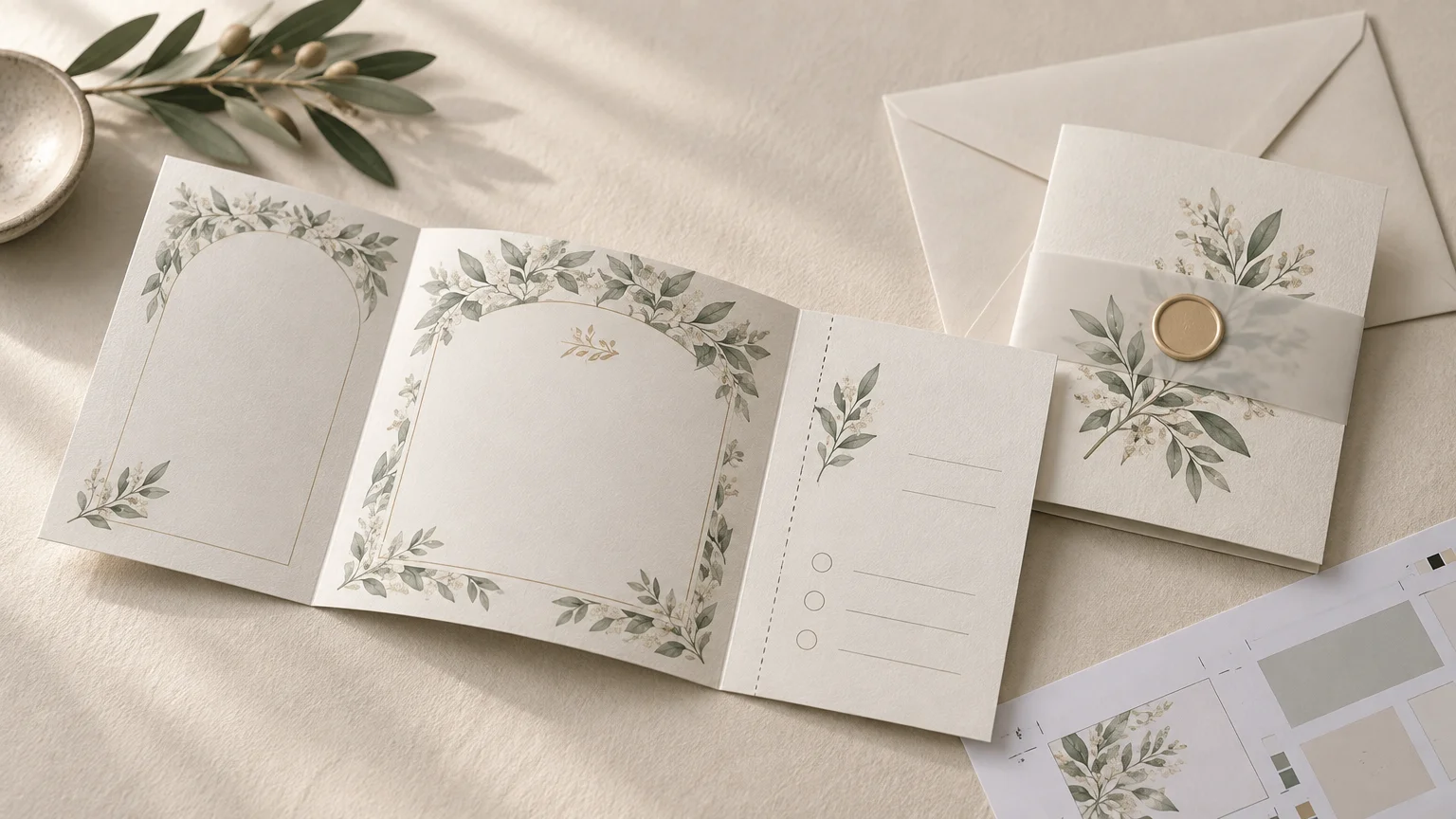
The phrase all in one wedding invitations can describe more than one product. Some retailers use it for a folded, self-mailing invitation that closes with stickers and includes a detachable RSVP postcard. Others use similar language more broadly for a streamlined invitation that combines the main details and a website or QR-based response prompt on one card. Zazzle, for example, uses the term for the specific folded, seal-and-send construction with a detachable response postcard. That does not mean every printer’s version has the same folds, perforation, closure, or mailing requirements.
The practical starting point is therefore not the style or price. First determine what “all in one” means for the product you are considering. Look at its finished dimensions, panels, RSVP method, addressing area, closures, paper choices, and whether an envelope is included or required. If those details are not stated clearly, ask before building your wording around the format.
Are all in one wedding invitations right for your event?
A compact invitation is a good candidate when guests need only a modest amount of information: who is getting married, when and where the ceremony will occur, whether the reception follows, how to respond, and where to find any secondary details. It can reduce the number of loose pieces that must be collated and may simplify assembly.
The format becomes less useful when compression makes the invitation difficult to read. A destination wedding, weekend itinerary, shuttle schedule, multiple venue addresses, accommodation instructions, dress code, meal selection, and plus-one questions rarely belong in tiny type on the same panel. Moving secondary information to a wedding website can help, but guests should still be able to identify the event and understand how to respond without hunting for essential instructions.
| Format | Works well when | Main limitation | Verify before ordering |
|---|---|---|---|
| Folded self-mailer with detachable RSVP | The event is straightforward and paper responses are preferred | Limited writing space and product-specific folds or perforations | Finished construction, closure method, return-address setup, and RSVP postage |
| Single invitation with online RSVP | Guests are comfortable responding digitally | Some guests may overlook or struggle with the online process | Readable URL or QR code, response deadline, and backup response method |
| Traditional invitation suite | The event has several locations, events, or detailed response questions | More pieces require additional assembly and quantity planning | Card sizes, envelopes, insert order, total weight, and postage |
| Invitation plus one details card | You need some overflow space without a large suite | Still requires collating two pieces | Envelope fit, card hierarchy, and whether all critical details remain clear |
Choose according to communication needs rather than the assumption that fewer pieces are automatically better. If you keep cutting text, shrinking type, or removing useful instructions to fit a template, the format is probably too restrictive.
Decide what information must fit
The main invitation should identify the couple, wedding date, ceremony time, venue, location, and RSVP instructions. Supplementary information can go on an RSVP card, details card, or another insert. For help arranging the core language, use this guide to wedding invitation wording and etiquette.
Keep the visual hierarchy simple. The couple’s names, date, and location should not compete with a long paragraph of travel notes. Guests need to scan the invitation and understand the basic event before they interpret secondary instructions.
Move overflow details somewhere appropriate
Information that often belongs on a separate card or wedding website includes accommodation blocks, shuttle schedules, parking instructions, reception details at a second venue, registry guidance, child-attendance information, and a weekend itinerary. A wedding details card is a practical middle ground when one invitation panel is not enough but a large suite would be unnecessary.
A brief attire line may fit on the invitation or a secondary panel. If the dress code needs explanation, put the expanded guidance elsewhere rather than reducing the invitation’s type size. These dress code wording examples can help you state the expectation clearly without making it sound like a warning.
Choose an RSVP method before finalizing the design
Do not treat the RSVP section as leftover space. It has to collect the information you need in a form guests can understand. At minimum, state the response deadline and explain how to reply. If you need names, attendance counts, meal choices, dietary notes, or responses to multiple events, map those questions before choosing a compact format.
Detachable RSVP postcard
A detachable response panel keeps the paper reply connected to the invitation until the guest removes it. Confirm that the product is actually perforated and ask whether the return side can accommodate the return address, guest identification, response fields, and any required postage. Do not assume return postage is included or that a detachable panel automatically qualifies for a particular postal price.
Online or QR-code RSVP
A digital response can preserve space, especially when the form must collect meal choices or answers for several wedding events. Print the website address as readable text even if you also use a QR code. That gives guests an alternative if their phone cannot scan the code or they are reading the invitation away from a device.
Test the final QR code from a printed proof or representative printout, not only from the design screen. Confirm that it opens the intended page and that the page is published, mobile-friendly, and ready to accept responses. If some invitees may not use online forms, provide a phone number, email address, or another clear backup method.
Separate response card
A separate response card offers more room and may be easier to replace if the questions change before printing. It is also better suited to several meal selections or event-specific attendance questions. The tradeoff is another piece to proof, assemble, and account for in the mailpiece. Use these wedding RSVP card wording examples to plan the questions before choosing the card size.
Design the assembled invitation for mailing
A mailpiece is evaluated in its finished form, not as a flat design file. Dimensions, thickness, weight, flexibility, shape, closures, and address orientation can affect whether USPS treats it as a letter, postcard, flat, nonmachinable letter, or another category. The official USPS standards for retail letters, cards, flats, and parcels explain the applicable physical criteria.
That is why an invitation described as “self-mailing” should not be assumed to qualify automatically for a standard letter or postcard price. Folds, tabs or stickers, a detachable section, embellishments, and paper stiffness can change the finished piece. Postal prices also change, so check the current USPS Notice 123 rather than relying on a remembered rate or an old wedding budget worksheet.
Before purchasing postage, prepare one complete sample exactly as it will be sent. Fold and seal it, include every insert, write or print representative destination and return addresses, and add any planned decoration. Weigh and measure that finished sample, then take it to a Post Office if its classification or machinability is uncertain.
- Keep the recipient address area clear of decorative elements that could interfere with reading.
- Check that the chosen closure keeps every panel secured during processing.
- Confirm which panel faces outward and how the address should be oriented.
- Test pens on response-card stock if guests will write on it.
- Verify whether wax seals, ribbons, thick embellishments, unusual shapes, or rigid construction change handling or postage.
- Repeat the check if you change paper, add inserts, or alter the closure after testing.
Consider paper, folds, and print finish together
Paper is not only an appearance decision for an all-in-one format. The stock must also suit the required folds, perforation, closure, and mailing construction. A heavier or textured option that works well for a flat invitation may not be offered for a particular folded product.
PrintInvitations lists smooth, heavier, felt, eggshell, and pearlescent paper categories, as well as several coating and foil options, while noting that availability varies by product. Those options should not be interpreted as confirmation that every stock or finish is compatible with a self-mailer. Check the exact product configuration before designing around a texture, coating, or foil detail. For a broader explanation of how stock affects feel and production, see the guide to paper weight for wedding invitations.
Coated writing areas deserve particular attention. If guests must complete a detachable response card, verify that its surface accepts ordinary pen ink without smearing. Also check whether a fold crosses text, a QR code, foil, or a small decorative element. The digital layout may look continuous even though the physical fold interrupts it.
Proof the invitation as a working document
PrintInvitations states that every order receives a free digital proof. A proof is the moment to catch errors, not merely to approve the colors and artwork. Read every panel in its folded sequence and verify the names, date, day of the week, times, venue spelling, addresses, RSVP deadline, website address, QR destination, meal labels, and return address.
Print the digital proof at approximate finished size when possible. This will not reproduce the final stock or print finish, but it can reveal type that is too small, crowded response fields, a weak visual hierarchy, or text uncomfortably close to folds and trim edges. Ask another careful reader to check the wording against your venue contract and planning records rather than proofreading from memory.
Proof approval has financial consequences. PrintInvitations’ published policy says approved custom orders generally are not returnable or refundable for customer-supplied wording mistakes, approved-proof errors, an incorrect quantity, or ordinary screen-to-print color variation. It says qualifying errors caused in production, fulfillment, or shipping are reviewed for replacement. Review the current policy for the precise terms applying when you order.
Build a realistic quantity and ordering timeline
Count invitations by mailing household, not simply by guest total. Then add extras for late additions, addressing mistakes, returned or damaged mail, keepsakes, and photography. Include enough response pieces and closures for the same plan. Reordering a small quantity later may cost more and can create color or timing complications.
Build backward from the mailing date and keep the stages separate: wording and design, proof review and revisions, production, shipping to you, assembly and addressing, postal verification, and mailing transit. PrintInvitations currently publishes that most orders are produced within three business days or less and most ship within one business day, but proof approval affects when production begins. Faster shipping also does not eliminate production time. These details are time-sensitive and should be checked on the current turnaround page when ordering.
When a traditional suite is the safer choice
Use a traditional invitation with separate inserts when the compact format forces compromises that could confuse guests. Strong reasons to switch include several venues, a multi-day schedule, complex transportation, multiple RSVP questions, formal response-card preferences, or a guest list that needs different detail cards.
The alternative does not need to be an elaborate stack. PrintInvitations offers wedding invitations and matching save the dates, RSVP cards, details cards, thank-you cards, and related stationery, with options to begin from a template or supply finished artwork. An invitation plus one details card may provide all the extra space you need without creating a large suite.
Final decision checklist
- Confirm whether “all in one” means a folded self-mailer, detachable RSVP format, or simply a streamlined invitation.
- List every detail guests need before selecting a template.
- Choose paper, detachable, or online RSVP handling and provide a clear deadline.
- Confirm product-specific dimensions, folds, closures, perforation, paper compatibility, and addressing setup.
- Proof every panel in the order guests will read it.
- Assemble one complete sample and verify current USPS classification and postage.
- Count by mailing households and order practical extras.
- Allow separate time for proofing, production, shipping, assembly, postal checks, and mailing.
All in one wedding invitations are most successful when they simplify a genuinely simple message. Start by writing the information and response questions, then choose the construction that holds them legibly and mails predictably. If the wording becomes crowded or the postal setup remains unclear, use an invitation with a separate RSVP or details card instead. The next practical step is to make a full-size paper mockup and test the complete assembled mailpiece before approving the order.
References
- All-In-One Wedding Invitations with RSVP Cards | Zazzle
- All in One Wedding Invite | Zazzle
- Wedding Invitations – PrintInvitations
- 100 Retail Mail Letters, Cards, Flats, and Parcels | Postal Explorer
- Notice 123 | Postal Explorer
- Paper & Print Options – PrintInvitations
- PrintInvitations | Custom Invitations, Announcements & Cards
- Proofing & Personalization – PrintInvitations
- Refund and Returns Policy – PrintInvitations
- Turnaround Time & Shipping – PrintInvitations